


Feeder Report 2026 - Offshore Renewable Energy Generation
Executive Summary
The OSPAR Maritime Area has undergone a profound transformation in its offshore energy landscape since the Quality Status Report (QSR) 2023. Offshore wind remains a dominant and rapidly expanding use of coastal and shelf seas within the region, while tidal, wave, and emerging technologies such as floating solar are progressing through the pre-commercial phase. This feeder report summarises current distribution, trends and environmental status, and identifies key management and governance considerations for OSPAR Contracting Parties.
European offshore wind capacity grew from approximately 22 GW in 2019 to approximately 36.7 GW by end-2024, with the United Kingdom (~16.6 GW), Germany (~9.7 GW), the Netherlands (~4.7 GW), Denmark (~2.6 GW), Belgium (~2.3 GW), and France (~1.5 GW) accounting for the majority of deployed capacity. Development is concentrated in the Greater North Sea and Celtic Seas sub-regions, reflecting their favourable wind resources and shallow-water conditions. Average turbine capacity for new installations now exceeds 9.5–10.5 MW, wind farm sizes average approximately 950 MW, and projects are increasingly sited further from shore in water depths of 35–40 m or greater.
Floating wind has advanced from demonstration to early commercial scale, with approximately 231 MW operational by end-2024 across Norway, the United Kingdom, France, Portugal, and Spain. Projections for European floating capacity by 2030 have been revised downward, with recent analysis suggesting up to 1 GW may be achievable, reflecting ongoing challenges in establishing commercial-scale auction pipelines and manufacturing capacity.
Tidal and wave energy remain in earlier stages of development. Operational ocean energy capacity in the EU stood at approximately 2.82 MW by end-2024, predominantly through pilot and demonstration projects. The MeyGen tidal stream project (6 MW, Scotland) is the largest operational array in the OSPAR Maritime Area. A publicly funded pipeline of approximately 165 MW is planned for deployment by 2030. Wave energy remains minimal, with total operational capacity in the OSPAR Maritime Area of approximately 1.12 MW. Floating solar is progressing through early-stage marine pilots, including the 0.5 MWp Merganser project in the Dutch North Sea.
EU Member States have adopted collective non-binding ambitions of 109–112 GW of offshore wind by 2030 and 281–317 GW by 2050, with North Sea countries jointly targeting approximately 120 GW by 2030. National plans across the region reflect significant upward revisions in ambition, although permitting delays, auction design constraints, grid integration challenges, and supply chain limitations remain material risks to achieving the highest deployment scenarios. A major expansion of the offshore renewable energy footprint in the OSPAR Maritime Area is nonetheless expected across the coming decade and beyond.
The wider European wind industry generated €86.8 billion in revenues and supported approximately 363,000 jobs in 2024, with the EU offshore wind sector alone contributing €5.3 billion in gross value added by 2022. The European Commission projects up to €800 billion in investment to meet 2050 targets, while the UK government anticipates unlocking £60 billion in further investment through GB Energy. Economic activity from tidal, wave, and floating solar is growing but remains substantially smaller.
The scale of current and projected offshore renewable energy development introduces a range of environmental pressures. Key concerns include physical loss and disturbance of seabed habitats; impulsive and continuous underwater noise affecting marine mammals and fish; collision and displacement risks for seabirds and bats; electromagnetic field effects from subsea cables; and chemical emissions from coatings, corrosion protection systems, and operational fluids.
Of particular concern is the potential for cumulative and systemic effects under large-scale, high-density deployment scenarios. Modelling studies indicate that dense offshore wind clusters in the Southern North Sea could alter local wind fields, wave climate, tidal amplitudes, water column stratification, and sediment transport, with cascading consequences for primary production and food-web dynamics. These basin-scale hydrodynamic effects are not adequately captured by project-level Environmental Impact Assessment (EIA) processes alone.
For tidal and wave energy, evidence on environmental interactions remains limited, particularly regarding the linkages between hydrodynamic alteration and ecological outcomes at population or ecosystem scales.
OSPAR has produced guidance on environmental considerations for offshore wind farm development since 2008 and established the Intersessional Correspondence Group on Offshore Renewable Energy Developments (ICG-ORED) to develop common principles and guidance. OSPAR has committed to developing an updated approach on decommissioning of offshore renewable energy installations by 2027. The European Commission's 2020 Offshore Renewable Energy Strategy and subsequent 2023 communication emphasise strategic environmental assessment, comprehensive monitoring, data exchange, and adaptive management. However, the evolving EU regulatory framework, including the designation of renewable acceleration areas under the Renewable Energy Directive (RED) III, may reduce EIA data availability in some Contracting Parties, reinforcing the need for robust regional data-sharing mechanisms.
Overall, offshore renewable energy is becoming a structural feature of the OSPAR maritime space and will remain so for the foreseeable future. The priority challenge is not only to facilitate deployment at the pace required by climate targets, but to ensure that cumulative, cross-border, and long-term environmental effects are anticipated, monitored, and adaptively managed. This will require strengthened regional coordination; harmonised monitoring standards; integrated spatial planning that moves from project-level EIA toward ecosystem-scale assessment; and targeted investment in the priority evidence gaps that currently constrain consenting and cumulative risk appraisal.
Introduction
1.1 This report summarises the status of marine renewable energy generation within the OSPAR Maritime Area and measures taken to manage its environmental impacts. It briefly notes key messages from the OSPAR Quality Status Report (QSR) 2023 and the Intermediate Assessment (IA) 2017, and reports on progress since then.
Distribution, Intensity and Trends since QSR 2023
Overall trends – offshore wind
2.1 The QSR 2023 observes that offshore wind has firmly established itself as a dominant and rapidly expanding use of coastal and shelf seas in the OSPAR Maritime Area. Globally, installed offshore wind reached ~83 GW by the end of 2024; Europe’s share in this global total fell from ~75% in 2019 to around 45% in 2024 as other regions, particularly China, have accelerated deployment (European Commission, 2020c; GWEC, 2025). Floating wind has progressed from demonstration projects to early commercial scale in OSPAR waters, led by Hywind Tampen (88 MW, Norway) and Kincardine (50 MW, United Kingdom), with pilot floating developments also operating off France, Portugal, Norway and Spain (GWEC, 2025).
2.2 Parts of the OSPAR Maritime Area remain exceptionally favourable for offshore wind. The North Sea combines extensive shallow banks for bottom-fixed turbines with high, steady wind speeds, while the Atlantic margin (Iberian–French–Irish–Norwegian coasts) offers deep-water resources suited to floating technology (IEA, 2024; WindEurope, 2025). As an overall ambition, European Union Member States that are signatories to the Hamburg declaration as well as the United Kingdom aim to develop up to 100 GW of our joint 300 GW ambition through cross-border cooperation projects by 2050 in the North Seas. Within Europe, the United Kingdom, Germany, the Netherlands, Denmark and Belgium continue to have the largest proportion of deployed capacity, with France now adding its first gigawatt-scale projects and expanding its auction pipeline (WindEurope, 2025; IEEFA, 2024; WindEurope, 2024b).
2.3 By the end of 2019, Europe had 22,1 GW of installed offshore wind (WindEurope, 2020). By September 2025, this had risen to 37 GW, produced by several thousand turbines across OSPAR countries (WindEurope, 2025a). This expansion in offshore wind is predicted to continue in coming years (Figure 1).
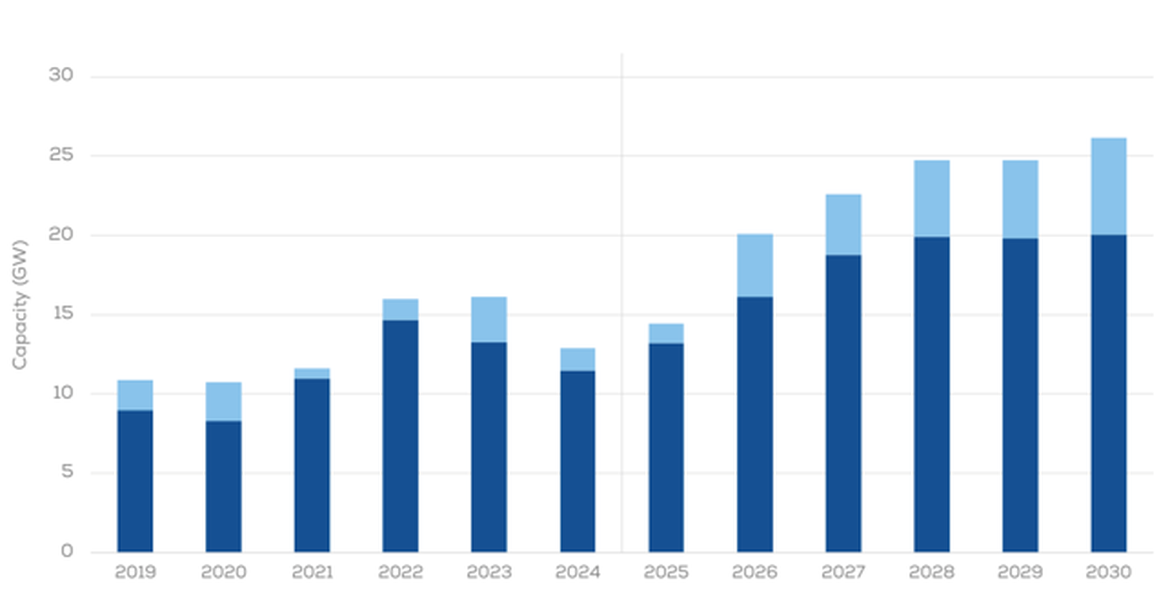
Figure 1: Annual wind power installations in the EU from 2019 to 2024 and projections for 2025 to 2030. Dark blue shows onshore wind installations, and light blue shows offshore wind installations. Source: WindEurope, 2025a
2.4 As illustrated in Figure 2, cumulative national capacities in the OSPAR Maritime Area are currently approximately: United Kingdom ~16,6 GW, Germany ~9,7 GW, the Netherlands ~4,7 GW, Denmark ~2,6 GW, Belgium ~2,3 GW, and France ~1,5 GW (WindEurope, 2025a) (IEEFA, 2024). Floating wind operating in the OSPAR Maritime Area at end-2024 totalled ~231 MW across Norway (101 MW), United Kingdom (78 MW), France (27 MW) Portugal (25 MW) and Spain (7 MW, 5 of which are located in the Canary Islands) with larger commercial arrays in development (GWEC, 2025). The North Sea continues to account for the majority of European offshore wind capacity, with the Celtic Seas as a secondary hub (WindEurope, 2025). Figure 3 shows the distribution of offshore wind installations within the OSPAR Maritime Area.
Figure 3: Details of the location and status of offshore renewable energy developments in the OSPAR region
Source: https://odims.ospar.org/en/submissions/ospar_offshore_renewables_2025_02/
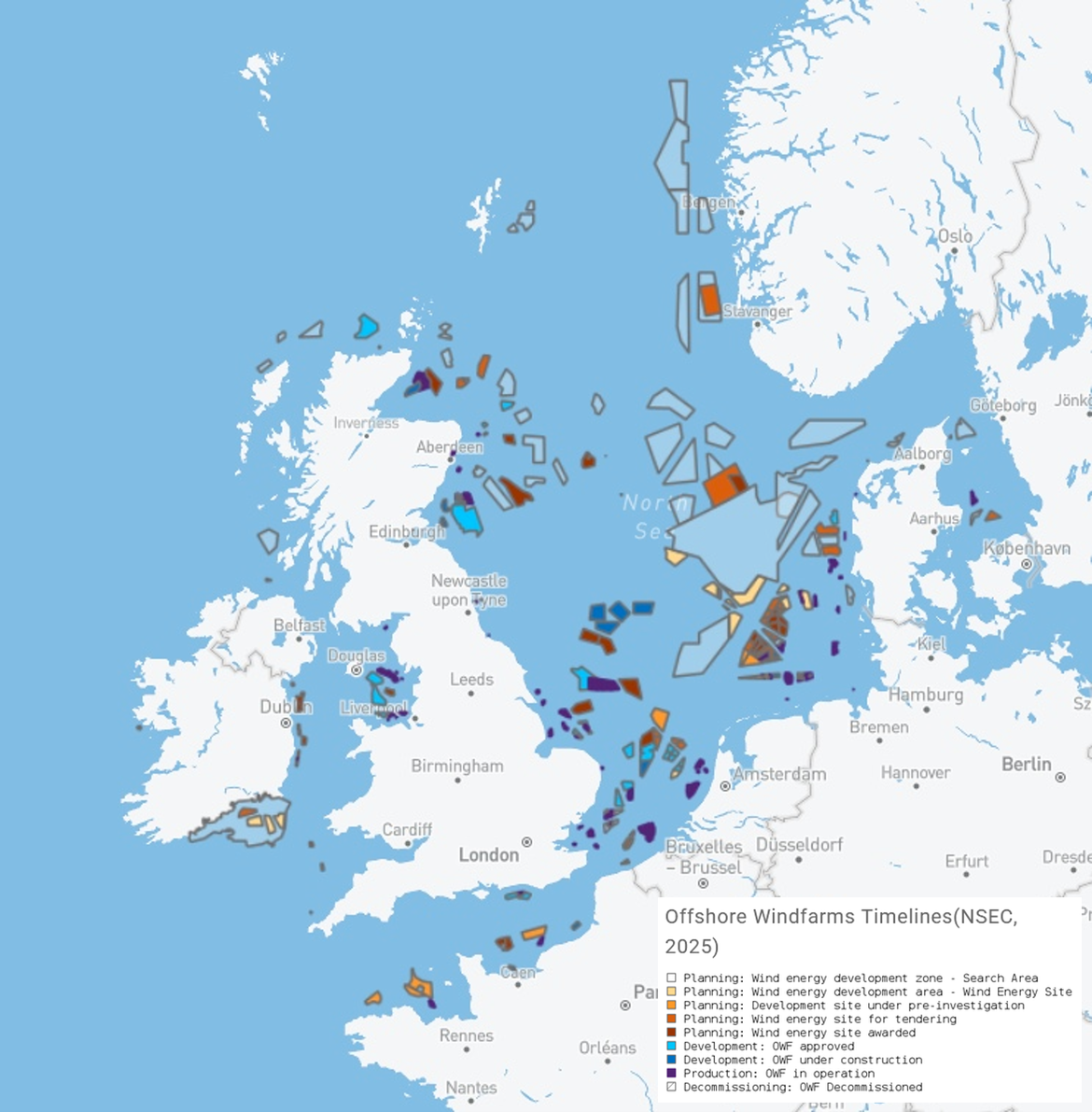
Figure 4: Details of the location and status of offshore renewable energy developments in the OSPAR region
Source: https://viewer.openearth.nl/compendium-greater-north-sea
2.5 The average rated capacity of offshore wind turbines, the size of wind farms and the distance to shore have all continued to grow since 2019. By 2024, the average turbine capacity for new installations in Europe reached 9.5–10.5 MW, with several projects deploying 14–15 MW prototypes and commercial rollout of 16–18 MW class turbines expected by 2025–2026 (WindEurope, 2025; GWEC, 2025). Average wind farm size for projects commissioned in 2024 was ~950 MW, compared with 621 MW in 2019 (WindEurope, 2025). The average distance to shore for new European offshore projects increased to ~65–70 km and water depths frequently exceed 35–40 m, particularly in the North Sea and Atlantic margin, with bottom-fixed technology still dominant but floating foundations gaining traction (IEA, 2024; WindEurope, 2025).
2.6 Costs have fallen further, with strike prices for recent European auctions ranging from €37–65/MWh (LCOE), and zero-subsidy bids gaining interest in Germany and the Netherlands up to 2024 (Taylor Wessing, 2024; IEA, 2024). However, both of Germany's 2025 zero-subsidy offshore wind auctions failed to attract sufficient bids prompting calls for a move to contract for difference (CfD) mechanisms, which are common across most of Europe (Offshore, 2025; Wind Europe, 2025b).
2.7 Floating offshore wind has moved from pilot to early commercial scale in the OSPAR Maritime Area. In 2019, only 45 MW of Europe’s capacity came from floating platforms (European Commission, 2020a). By end-2024, ~231 MW of floating capacity was operational across Norway, the United Kingdom, France, and Portugal, with the largest projects being Hywind Tampen (88 MW, Norway) and Kincardine (50 MW, United Kingdom) (Equinor, n.d.; GWEC, 2025). In France, the Provence Grand Large demonstrator started operating in late 2024 (IEEFA, 2024). Floating technology types in operation now include spar-buoy, semi-submersible, and tension-leg platforms, reflecting the move beyond single-prototype deployments to multiple-platform arrays (IEA Wind TCP, 2023; GWEC, 2025). Projections indicate Europe may reach 1,8 - 2 GW of floating capacity by 2030, with France, Norway, Spain, the United Kingdom and Portugal leading in auctioned pipeline volume (WindEurope, 2025; IEEFA, 2024). However, recent analysis by WindEurope suggest that this may no longer be feasible, with new projections of up to 1 GW by 2030 (A. Marques, personal communications, September 2025). This projection reflects the current stage of technology maturity: large-scale deployment will depend on unlocking full industrialisation of floating platforms, which in turn requires a stable and predictable pipeline of commercial-scale auctions. Progress toward 2030 will therefore hinge on both policy stability and the establishment of manufacturing capacity at scale.
Overall trends – wave and tidal
2.8 Within the OSPAR Maritime Area, the Atlantic Ocean has good natural potential for wave and tidal energy, and the North Sea also has localised potential (European Commission, 2020a).
2.9 By the end of 2024, the EU’s emerging operational ocean energy capacity (i.e. capacity excluding existing projects) amounted to 2,82 MW (with 1,63 MW of tidal, 1,12 MW of wave, and 70 kW of salinity gradient energy), reflecting continued pilot and demonstration projects (European Commission, 2025). In 2023, globally ocean energy capacity reached 508 MW, with Europe accounting for roughly half with 243 MW (European Commission, 2025; IRENA, 2024).
2.10 In 2024 the European wave and tidal sector continued to advance steadily, with five developers deploying new devices across the region and a publicly funded pipeline of around 165 MW planned for deployment by 2030, signalling growing momentum towards commercialisation (Ocean Energy Europe 2025).
2.11 Advice to OSPAR from the International Council for the Exploration of the Sea (ICES) in 2019 summarised the types and distribution of tidal and wave energy installations, potential future trends, and environmental impacts (ICES, 2019). Key messages from the advice are summarised briefly in sections 2, 4 and 6 of this feeder report.
2.12 ICES identified 43 MW of tidal energy devices operational across the OSPAR Maritime Area in 2019, with more than 320 MW under construction, consented, or in planning phases. Tidal energy installations include different types of turbines, hydrofoils, Archimedes screws, and tidal kites. In the OSPAR Maritime Area, the United Kingdom had the largest level of deployment, with test centres and commercial sites under development. Operational or planned developments also existed in France, Belgium, the Netherlands, Norway, and Spain (ICES, 2019).
2.13 By 2024, the MeyGen tidal stream project in Scotland was the largest operational array in the OSPAR area at 6 MW, with expansion phases under development for a total of 398 MW (Offshore Energy, 2024; MeyGen, 2012). Other United Kingdom initiatives, such as the Nova Innovation array in Shetland, are expanding capacity under CfD (Blackfish Engineering, 2025). In France, the Normandy Hydrolienne 1 (NH1) project is expected to deliver 4–5 MW of tidal stream energy by 2028 with EU innovation funding (European Commission, 2025).
2.14 Tidal energy can also be obtained using barrages across estuaries or by enclosing a tidal lagoon. The long-established barrage at La Rance in France remains the world’s first tidal power station with a peak capacity of 240 MW; there are currently no plans for further barrage developments in France (European Commission, 2025). Environmental concerns continue to limit the feasibility of new tidal barrages in the OSPAR Maritime Area, though installation of turbines in existing coastal infrastructure remains viable (ICES, 2019).
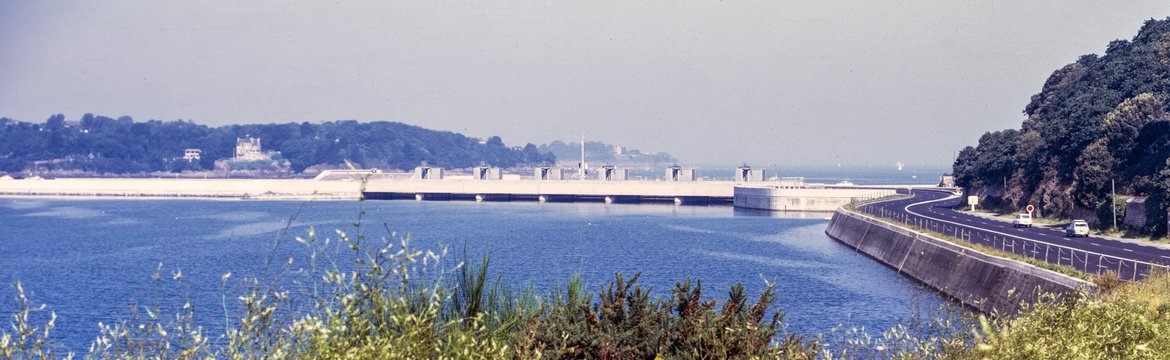
Tidal energy can be obtained using barrages across estuaries or by enclosing a tidal lagoon. The long-established barrage at La Rance in France remains the world’s first tidal power station.
2.15 In the case of wave energy, ICES reported that the OSPAR countries best suited for the technology are the United Kingdom, Ireland, and Norway, followed by Spain, France, and Portugal (ICES, 2019). Current operational projects remain small-scale or demonstration-level, with peer-reviewed studies highlighting both resource potential and variability challenges (Ibarra‑Berastegi et al., 2018).
2.16 A coastline infrastructure energy plant (turbines housed in a breakwater) with a capacity of ~300 kW remains operational in northern Spain (Ibarra‑Berastegi et al., 2018), and a range of devices are being trialled within the OSPAR Maritime Area. Excluding test centres, total operational wave energy in the OSPAR Maritime Area remains minimal (~1,12 MW) as of 2024, with ~20 MW consented or in planning phases (European Commission, 2025). To date, there are no operational commercial-scale nearshore fixed or floating wave energy developments within OSPAR Regions.
2.17 Emerging concepts such as floating solar or Ocean Thermal Energy Conversion (OTEC) are also under review as part of broader marine energy research initiatives (Copping et al., 2025) In 2025, a 0.5 MWp offshore floating solar pilot (the Merganser project) was installed in the Dutch North Sea approximately 12 km off Scheveningen, marking an important demonstration of offshore photovoltaic technology operating in high-energy marine conditions and highlighting emerging co-location potential alongside offshore wind infrastructure.
Growth of Offshore Wind
3.1 The EU’s Blue Economy report 2025 included economic data for the EU offshore wind energy (production and transmission) sector. The report highlights strong growth in both activity and economic output in the early 2020s and gives figures through 2022 (with estimates into 2023) for the sector across the EU (European Commission, 2025). Specifically:
- Employment in the EU offshore wind energy sector reached 17 300 people in 2022, with provisional estimates of 18 400 for 2023. Average wages rose to €72 100.
- Gross value added (GVA) grew to €5,3 billion in 2022 (42% up from 2021), while profits rose to €4,1 billion.
- Installed capacity reached 18,9 GW in the EU by 2022, with the United Kingdom contributing approximately 15 GW by 2023 and targeting 50 GW by 2030.
3.2 While 2024 data were not yet available at the time of publication of the EU Blue Economy report 2025, complementary analyses (WindEurope, 2025c) provides updated figures on employment, value added, and revenues for the wider European wind industry:
- the European wind industry (onshore + offshore) generated €86,8 billion in revenues and contributed €54,4 billion to Europe’s GDP in 2024.
- Each GW of offshore wind installed in Europe generated an estimated €4,4 billion in value added, while each onshore GW contributed around €3,5 billion.
- The sector sustained 363 000 jobs, of which 338 000 were in the EU. Direct employment reached approximately 195 500, marking the ninth consecutive year of growth.
- The wind industry contributed €9,8 billion in taxes, including €2,3 billion in local and non-corporate taxes benefiting regional governments and communities (WindEurope, 2025).
3.3 The wider supply chain for offshore wind continues to create substantial employment beyond coastal regions. As of 2025, the United Kingdom wind industry supports 55 000 jobs, of which ~40 000 are in offshore wind (RenewableUK, 2025). EU manufacturing and component assembly have similarly expanded in inland regions, particularly in Germany, Denmark, and the Netherlands (European Commission, 2025; WindEurope, 2024).
3.4 Economic activity in tidal and wave energy remains smaller than offshore wind but is growing. Pilot and demonstration projects across the EU are increasing, and employment is projected to rise as new pre-commercial farms come online (Ocean Energy Europe, 2024; JRC, 2024).
3.5 OSPAR countries continue to compete globally in offshore renewable technologies, with Europe maintaining a strong position in fixed-bottom and floating wind. According to the Global Wind Energy Council’s (GWEC) Global Offshore Wind Report 2025, global offshore wind capacity reached 83 GW, with Europe holding around 40% of the total, with the majority of the remainder coming from China (GWEC, 2025). The EU and UK also retain strong export positions for offshore wind equipment and services (European Commission, 2025).
3.6 Major investment continues to support offshore renewable ambitions. The European Commission projects up to €800 billion in investment to meet 2050 targets (European Commission, 2025). The United Kingdom government anticipates £20–30 billion in additional private investment by 2030, with the creation of GB Energy in 2025 projected to unlock £60 billion of further investment (UK Government, 2025). Industry analyses state that maintaining stable policy frameworks and competitive supply-chain capacity will be critical for this investment to maximise returns (WindEurope, 2025c).
Future Trends
4.1 A further major expansion of offshore renewable energy is anticipated in the OSPAR Maritime Area in the coming decade and beyond, primarily of offshore wind but also involving tidal and wave power. There may also be developments of other novel technologies. The pace and extent of deployment will depend on stable market frameworks, supply-chain resilience, and coordinated maritime spatial planning including the consideration of multi-use in some areas.
4.2 Co-location opportunities of marine renewable energy infrastructure with other uses are being investigated, in particular in relation to offshore shellfish culture. The Edulis project in Belgium trialled offshore mussel culture in a wind farm and concluded that mussel culture in Belgian wind farms is biologically and technically feasible under certain designs and site conditions (Edulis/BlueGent, 2019; project summary updated 2021). Studies and pilots on using wind farm infrastructure for flat-oyster restoration have been advanced in the Netherlands (van Duren et al., 2022) and several recent feasibility projects and trials in 2024–2025 (including industry–research pilots) indicate that oyster reef restoration within or adjacent to wind farm footprints is technically feasible and can be designed to provide biodiversity benefits while managing regulatory and operational constraints (Wageningen/Van Duren et al., 2022; RWE & The Oyster Restoration Company, 2025). Lifecycle and ecological assessments continue to identify knowledge gaps (e.g., cumulative benthic effects, trophic interactions) that require further monitoring and site-specific appraisal before wide replication (Wageningen Marine Research, 2024; Griffin et al., 2015).
Future trends – offshore wind
4.3 The European Commission’s 2020 strategy on offshore renewable energy envisages an expansion in offshore wind from the current installed capacity of around 12 GW in EU Member States to at least 60 GW by 2030 and 300 GW by 2050 (European Commission, 2020c). Since 2020, Member States and regional bodies have adopted more ambitious non-binding objectives. In 2023 Member States agreed a higher collective ambition for offshore renewables in 2030, in the order of 109–112 GW by 2030 (non-binding aggregate range), and 281–317 GW by 2050 depending on the pathway used (European Commission / Member State communication, 2023). The North Seas Energy Cooperation (NSEC) and other regional agreements have likewise updated regional ambitions for the North Sea and neighbouring basins (NSEC / EC, 2022–2023). These revised ambitions reflect (a) accelerated national pledges in many states, (b) stronger policy signals in EU instruments (including the 2023 wind strategy and related actions), and (c) recognition of the need for very large investment in grids and ports to deliver the scale-up.
4.4 A report by WindEurope states that permitting bottlenecks, auction design, and grid connection constraints remain among the principal barriers to achieving these ambitions, prompting reforms such as the designation of “acceleration areas” according to the amendments of the Renewable Energy Directive (RED) III and the intention for standardised Contracts for Difference (CfD) frameworks now adopted in most EU states (WindEurope, 2025c). The Commission’s 2025 guidance on two-way Contracts for Difference (EC 2025c), part of the EC European Grids Package, emphasises the need for greater standardisation of CfD design across Member States to improve investor confidence, reduce fragmentation, and strengthen the functioning of the internal electricity market. It encourages harmonised core features, including strike price structures, duration, settlement mechanisms, and claw-back arrangements, so that CfDs provide predictable revenue support while ensuring consistency with EU market rules and minimising distortions between national schemes. This cooperation has the aim of increasing the speed of deployment in OSPAR waters, which in turn will increase the need to adequately manage the associated environmental pressures.
4.5 The European Commission’s 2020 strategy identifies various challenges associated with the expansion to 2050, and ways to address them. These include effective maritime spatial planning, ensuring coexistence with other uses of the sea, as well as compliance with environmental legislation (see section 6 below). While the strategy states that expansion of offshore energy is not incompatible with shipping routes, it also notes the importance of risk management, given that the areas with most potential for offshore renewable energy are the most exposed to tensions with other uses, such as risks of collisions with vessels, fishing gear, military activities, or dumped ammunitions and chemicals. Other areas to address include grid planning, the energy market framework (more on market arrangements is at European Commission, 2020d), EU financing mechanisms, and research and development. Regional cooperation in sea basins is highlighted, such as through the existing NSEC mechanism (NSEC, 2020).
4.6 In addition, regional coordination on maritime spatial planning and environmental assessment has been further enhanced through the Greater North Sea Basin Initiative (GNSBI), launched by the European Commission in 2023. The GNSBI brings together North Sea OSPAR Contracting Parties — Belgium, Denmark, France, Germany, Ireland, the Netherlands, Norway, Sweden, and the United Kingdom — alongside the European Commission and relevant stakeholders. Its purpose is to strengthen cooperation on marine spatial planning (MSP), environmental data sharing, and alignment of cumulative impact assessment methodologies. The initiative complements existing mechanisms, including NSEC, by promoting cross-border data exchange, joint planning approaches, and ecosystem-based management across the wider North Sea basin, supporting both EU and OSPAR objectives (European Commission, 2023d).
4.7 The Commission’s strategy highlights the potential for wind energy in different sea basins but does not specify where the increase in European installed capacity will occur in the next decade, or beyond. Precise locations will depend on factors such as available space, sea depths, wind speeds, cost, environmental constraints and where energy demand is located. Examples of updated national and regional ambitions and plans include:
- For the North Sea: The NSEC (ministerial and joint declarations 2022–2023) set out more ambitious regional trajectories than in 2019, with intermediate regional targets for the North Sea in the period to 2030/2040 (76 – 86 GW) and a long-term joint ambition out to 2050 (180-200 GW). Specific NSEC joint declarations in 2022–2023 frame an aggregated regional ambition substantially above the earlier 70 GW figure for some member states, while recognising uncertainty across member states’ pipelines. (European Commission, 2025b)
- The Netherlands: The government significantly increased offshore ambition after 2018: there is a roadmap for an ambition of 21 GW roll-out in 2032. In 2024–2025 some tenders were postponed because of insufficient developer interest in “zero-subsidy” rounds, moving some capacity delivery dates toward 2032 and beyond (Reuters, 2025). The initial ambition of 50 GW in 2040 was recently recalibrated to a bandwidth of 30-50 GW, and a new roadmap will follow.
- Belgium: National plans and recent licensing indicate Belgium is aiming to increase offshore capacity substantially by 2030 (indicative totals in the order of ~5–6 GW by 2030 depending on development of planned zones such as PEZ and additional extensions), with ongoing modular grid and port investments to accommodate growth (Belgian FPS Economy, 2025).
- Denmark: The energy-island concept remains a national priority; initial phases and tenders aim to deliver multi-GW hubs and when fully scaled could aggregate up to ~10 GW or more of hub-connected capacity in the North Sea over the longer term, although project timetables and costs have slowed some delivery milestones (Energistyrelsen, 2024).
- France: France aims to install 15 GW offshore-wind by 2035 and 45 GW by 2050, but analyses in 2024–2025 flag risks of slower deployment and the need for speeded permitting to realise higher scenario outcomes (IEA-WIND, 2023c; IEEFA, 2025).
- Germany: Government targets and legislative updates have raised ambitions (e.g 40 GW by 2035 and 70GW by 2045). Germany continues to plan large port and grid investments to unlock deployment in the German North Sea and Baltic areas (Clean Energy Wires, 2024; German Offshore Wind Energy Foundation, 2025).
- Ireland: Ireland maintains an ambition of 5 GW of operational offshore renewables by 2030 under its Offshore Renewable Energy Development Plan II. Policy documents retain multi-GW targets, with updated national plans and maritime spatial planning underway to accommodate offshore wind, though realisation depends on permitting and supply-chain delivery (Government of Ireland, 2025).
- Sweden: Sweden has granted consent for three offshore wind projects in OSPAR waters, though no final investment decisions have yet been taken. Sweden has a techonolgy neutral goal of meeting an electricity demand of 300 TWh by 2045.
- Spain: In 2021, Spain published their National Integrated Energy and Climate Plan (PNIEC) 2021-2030. The Roadmap for the development of Offshore Wind and Marine Energies in Spain aims to reach between 1 and 3 GW of floating offshore wind and up to 60 MW of marine energies in pre-commercial phase by 2030 (Spanish Government, 2019 & 2021).
- Portugal: In 2025 the Portuguese Maritime Spatial Planning (Council of Ministers Resolution nº 203-A/2029, 31 of December), was updated with areas to allocate to commercial exploration of renewable energy, mainly floating wind energy, with a total installed capacity of 9,4 GW (Council of Ministers Resolution nº 19/2025, 7 of February). According with the revision of the National Climate and Energy Plan - PNEC 2030 (Resolution of the Portuguese Parliament nº 127/2025, 10 of April) until 2030 it is foreseen conditions to attribute and instal a capacity of 2 GW via auction procedures.
4.8 In the United Kingdom, aspirations for offshore wind are high to meet the demands of the Clean Power Action Plan which aims to deliver up to 50 GW of offshore wind capacity by 2030, including 5GW of floating wind, and deliver reforms to accelerate consenting and streamline project timelines. In addition to this government target, there is a potential need for up to 140 GW of offshore wind by 2050 to meet the requirements identified by the UK Climate Change Committee. Within this UK target, Scotland has raised its ambition considerably, moving from 11 GW by 2030 to 40 GW by 2035-2040, aligned with consultation on the updated Offshore Wind Sectoral Marine Plan 2025. The Crown Estate estimates that 20-30 GW of new seabed rights in England and Wales will need to be brought to market by 2030 for delivery out to 2040 (Crown Estate 2024). Key opportunity regions include:
- Celtic Sea - potential for up to 12GW, with 4-10 GW to be leased through future rounds by 2030.
- North-East - potential for up to 10-16 GW, with leases anticipated by 2030 and operations commencing between 2035 and 2040.
- Dispersed opportunities - smaller-scale projects (2-8 GW) in the Southern North Sea, English Channel, Welsh waters, and North-West England, also expected to come online from 2035-2040.
4.9 Other non-EU countries within the OSPAR Maritime Area have small expansion plans in the next decade. In Norway, the Government’s long-term ambition remains robust; in 2022 it set a target of 30 GW of offshore wind capacity by 2040. In recent years, two license areas, Sørlige Nordsjø II (Southern North Sea II) and Utsira Nord, have been opened and are advancing. The Sørlige Nordsjø II tender was awarded in March 2024 for a bottom-fixed project (1,5 GW capacity), while preparations are underway for floating wind tenders at Utsira Nord, three 500 MW project sites are open for applications, with a state-aid auction planned for between 2028 and 2029 to support floating wind commercialization (Norwegian Government, 2022). In the Faroe Islands, SEV’s planned 96–120 MW offshore wind farm near Tórshavn is expected to be commissioned by late 2025, according to company documentation, pending permits and environmental assessments (SEV, 2025).
4.10 Overall, most of the expansion of offshore wind in European seas to 2030 and beyond is still expected to be concentrated in OSPAR waters, although the updated aggregate EU and regional ambitions (now expressed in the 109–112 GW by 2030 non-binding range at EU level and higher regional North Sea ambitions) represent a substantial upward revision of expected capacity compared with the 2020 baseline (European Commission, 2023). Industry scenarios to 2050 continue to show very large potential, but recent industry reports and market intelligence claim that permitting, auction design, supply-chain limits and grid-integration remain critical constraints which, if not resolved, will slow deployment below the highest scenarios (GWEC, 2025). It has also been noted by some industry observers that the rapid decline in the cost of onshore solar and battery storage technologies has made offshore wind appear relatively more expensive in the short term (D. Wood, personal communications, September 2025).
4.11 The spatial implications remain large. Earlier Commission estimates suggested that ~380 GW in northern seas (including Baltic) could require ~76 000 km² of sea space (assuming 5 MW/km²) (European Commission, 2020d). However, more recent analyses by WindEurope suggest that most wind farms produce between 8-11 MW/km² and show that EU coastal Member States have already allocated approximately 52,000 km² for offshore wind in their Marine Spatial Plans, representing a potential of over 220 GW by 2030 (A/ Marques, personal communications, September 2025). Advancements in technology (bigger turbines, higher maximum theoretical power output or nameplate per km², and floating concepts) and different spacing assumptions mean that area-estimates depend strongly on turbine size and layout choices. Regional and site-specific spatial planning assessments, and growing attention to multi-use and nature-inclusive design, are now routinely built into licensing and MSP processes to reduce conflicts with fisheries, shipping, defence activities and nature conservation, though in some sub-regions proportions of sea area devoted to wind may be high and will require careful trade-off analysis (WWF,2024).
Future trends – wave and tidal energy
4.12 The current scale of tidal and wave energy installations remains smaller than offshore wind but has moved from demonstration to growing pre-commercial pipelines in Europe. ICES (2019) concluded that wet renewables were likely to be increasingly installed and that many projects were in planning, a position borne out by subsequent progress in prototypes and small arrays. During 2023–2024 several full-scale wave and tidal devices were deployed and by the end of 2024 cumulative electricity production from ocean energy in Europe reached ≈106 GWh, with a publicly-funded pipeline of roughly 165 MW planned for the next five years (Ocean Energy Europe, 2024; JRC, 2024). Technology trends for tidal devices show a movement towards lighter, floating and semi-floating concepts that reduce installation and maintenance complexity and access faster flows; tidal-lagoon concepts remain of interest but face significant economic and consenting challenges (ICES, 2019; JRC, 2024). Pilot and test programmes for wave energy have continued at sites in the United Kingdom, France, Spain, Norway and Ireland, with multiple developers progressing devices through full-scale sea trials in 2023–2024 (Ocean Energy Europe, 2024; European Commission, 2025).
4.13 Factors that could increase the opportunity for future developments include improved marine spatial planning tools, stronger evidence on environmental interactions from monitoring of early projects, revenue-support instruments or contracts that reduce market risk, and further technological maturation (e.g., standardised foundations, shared array infrastructure). However, many past applications have been withdrawn for financial or logistical reasons, and persistent barriers remain: device survivability and reliability in harsh sea states, uncertainty and site-specificity of environmental impacts, grid-connection and array-integration costs, and constrained investment conditions (ICES, 2019; IRENA & OEE, 2023; JRC, 2024). Recent sector reviews and techno-economic assessments indicate that cost reductions are achievable but will require both cumulative deployment and targeted learning investments (Santhakumar et al., 2024; IRENA & OEE, 2023).
4.14 European analysis concurs that the current installed base is a small fraction of total offshore renewables but that the resource potential is very large. The JRC estimates an annual potential in EU waters of 2 800 TWh for wave energy and 50 TWh for tidal current energy, predominantly off the Atlantic seaboard (JRC, 2024). EU policy targets set a minimum of 1 GW of ocean energy by 2030 under earlier strategic documents, with more ambitious scenarios (tied to research and market support) indicating tens of GW by mid-century if cost and financing barriers are overcome (European Commission, 2020c; JRC, 2024; European Commission, 2025). The 2025 EU Blue Economy Report notes progress in deployment and public investment but emphasises that ocean energy remains a small contributor to GVA and employment compared with offshore wind (European Commission, 2025).
4.15 At present there is no single dominant technology for tidal and wave energy, and significant cost reductions remain necessary for wide commercial uptake. Peer-reviewed techno-economic modelling and sector analyses show substantial potential for LCOE reductions with scale: example scenarios indicate tidal stream and wave LCOEs falling from hundreds of €/MWh at prototype scale to nearer the policy targets of €100/MWh at multi-GW cumulative capacity, depending on assumptions about capacity factor, CAPEX learning rates and OPEX improvements (Santhakumar et al., 2024; IRENA & OEE, 2023). The JRC and Ocean Energy Europe analyses indicate that achieving the earlier SET-Plan targets (e.g., ~100 MW pilots and cost steps by mid-2020s) has been partially met through the growing pilot pipeline, but that stepping from pilot to first-of-a-kind array (100s of MW) will require continued public support, revenue certainty and coordinated industrial policy (JRC, 2024; Ocean Energy Europe, 2024; IRENA & OEE, 2023).
Other energy sources
4.16 Other offshore energy technologies remain nascent but are gaining traction through structured research, demonstration, and pilot programmes.
4.17 Marine Floating Solar Photovoltaic (FPV) systems have moved from small-scale experiments toward pilot installations in the coastal and offshore North Sea. Marine-specific environmental studies are already investigating fouling communities and potential ecological interactions (Mavraki et al., 2023). Broader reviews emphasise that marine FPV cannot simply replicate lessons from freshwater systems: challenges such as biofouling, shading impacts on benthic ecosystems, corrosion, anchoring, and mooring dynamics remain critical research areas (Rodríguez Castillo et al., 2024). These technologies are also being explored for co-use with aquaculture (“aquavoltaics”) and for powering remote coastal or island communities, but detailed cost-benefit analyses in the OSPAR context are still limited.
4.18 Research and strategy development in the North Sea region have rapidly advanced. Peer-reviewed studies and technical reports document growing research and development into producing “green” hydrogen offshore via electrolyzers powered by offshore wind or tidal turbines, with pilot configurations under investigation (Glaum et al., 2024; Farahmand, Günther & Kristiansen, 2024). Recent techno-economic studies indicate that coupling offshore wind with hydrogen production could reduce grid constraints and deliver cost savings in the OSPAR Maritime Area, though large-scale deployment still faces technological and economic barriers (Scottish Government, 2025; Rodríguez Castillo et al., 2024).
OSPAR Quality Status Report 2023 and Intermediate Assessment 2017
5.1 The QSR 2023 acknowledges the substantial growth of offshore wind energy in the North-East Atlantic since the QSR 2010 assessment. While this expansion contributes to climate change mitigation, it also introduces several environmental pressures. These include:
- Physical Loss and Disturbance: Permanent changes to seabed substrate, morphology and habitat, as well as temporary disturbances during construction and operation.
- Hydrological conditions: Cumulative impacts from the modification of currents, turbulence, stratification and sediment transport patterns.
- Noise Pollution: Both impulsive and continuous noise from activities such as pile driving during installation and operational noise, which can affect marine mammals and other marine life.
- Collision Risks: Potential for birds and bats to collide with turbine structures.
- Electromagnetic Fields (EMFs): From subsea cables, which may impact marine species sensitive to magnetic fields.
- Light and Heat Emissions: From turbines and associated infrastructure, potentially affecting marine organisms.
- Chemical Emissions: Primarily from anti-corrosion coatings, antifouling treatments, hydraulic fluids, lubricants, and accidental leaks of transformer oils or other maintenance-related substances.
5.2 These pressures can lead to changes in ecosystem state, either singly or collectively, resulting in cumulative effects on marine biodiversity and ecosystem services.
5.3 Despite the advancements in offshore wind energy development, significant knowledge gaps remain regarding the long-term environmental impacts which are addressed in more detail in later sections. The QSR 2023 emphasises the need for:
- Long-Term Monitoring: To assess the cumulative and synergistic effects of offshore wind farms on marine ecosystems.
- Data Sharing: Enhanced collaboration among OSPAR Contracting Parties to improve data availability and quality.
- Adaptive Management: Implementing flexible management strategies potentially including nature inclusive designs that can be adjusted as new information becomes available.
5.4 The QSR 2023 also highlights the importance of developing common principles and guidance to promote and facilitate the sustainable development of offshore renewable energy, ensuring that cumulative environmental impacts are minimised.
5.5 Although the QSR 2023 notes that other forms of marine renewable energy, such as tidal and wave energy, remain in the early stages of research and demonstration, this is no longer the case, reflecting the pace at which this market is moving to commercialisation. Impacts in this area are detailed more fully below.
Analysis of Specific Pressures, Impacts and Measures
6.1 Understanding and managing the environmental impacts of the substantial existing and future growth of offshore renewable energy are essential for its sustainable development. The European Commission's Offshore Renewable Energy Strategy, published in November 2020, acknowledges the substantial growth of offshore renewable energy and emphasizes the need for comprehensive monitoring and scientific research to understand and mitigate potential environmental impacts. The strategy highlights the importance of in-depth analysis, data exchange, and the development of modelling tools to assess cumulative effects on the environment and interactions with other maritime activities. It also proposes the establishment of a 'community of practice' to promote the sharing of experiences and collaborative efforts among stakeholders.
6.2 In October 2023, the European Commission presented a Communication titled "Delivering on the EU Offshore Renewable Energy Ambition," which builds upon the 2020 strategy (European Commission, 2023b). This communication outlines measures to accelerate the development of offshore renewable energy, including streamlining permitting processes, enhancing regional cooperation, and supporting supply chains.
6.3 Furthermore, the European Commission has published revised guidance on wind energy developments and EU nature legislation, aiming to ensure that offshore renewable energy projects comply with environmental protection standards and contribute to the EU's biodiversity objectives (European Commission, 2023c).
6.4 In addition to regulatory compliance, recent syntheses emphasise that the scale of projected offshore renewable expansion requires a transition from project-level impact assessment toward ecosystem-scale understanding. The European Marine Board highlight that large-scale deployment in European seas necessitates integrated observing systems, long-term monitoring and improved modelling capacity to assess cumulative ecological change (Soukissian et al 2023). This reflects a broader shift from assessing isolated impacts toward understanding system-wide ecological responses.
6.5 Although construction and operation have historically received the greatest attention, empirical evidence on the ecological implications of decommissioning remains extremely limited. A recent global synthesis found no peer-reviewed empirical studies directly assessing ecological impacts of offshore wind decommissioning (Watson et al 2024). Work is underway within OSPAR’s group on Offshore Renewable Energy Developments (ICG-ORED) to develop draft common principles for a regional sea approach to decommissioning.
Impacts and measures – offshore wind deployment
6.6 OSPAR produced Guidance on environmental considerations for the development of offshore wind farms (OSPAR Agreement 2008-03) in 2008 (OSPAR, 2008). The guidance aimed to assist those involved with developments to identify and consider issues that may be associated with the environmental impacts of developments, covering location, licensing, monitoring, construction and operation, and decommissioning. A 2020 OSPAR survey of its Contracting Parties showed that the offshore wind guidance was generally fully implemented, or that implementation was in progress, although not all Contracting Parties provided information for the survey. The ICG-ORED 26-27 terms of reference contains a task to update the 2008-3 guidance, which is currently in progress. OSPAR also maintains a database of individual marine renewable developments, including tidal and wave as well as offshore wind.
6.7 Since 2020, OSPAR has continued to prioritise the sustainable development of offshore renewable energy. In 2021, OSPAR established ICG-ORED to develop common principles and guidance for the sustainable development and scaling up of offshore renewable energy, aiming to minimise cumulative environmental impacts (OSPAR, 2021). By 2023, OSPAR developed common principles, and by 2024, guidance was developed to promote and facilitate sustainable development and scaling up of offshore renewable energy in a way that cumulative environmental impacts are minimised (OSPAR, 2023).
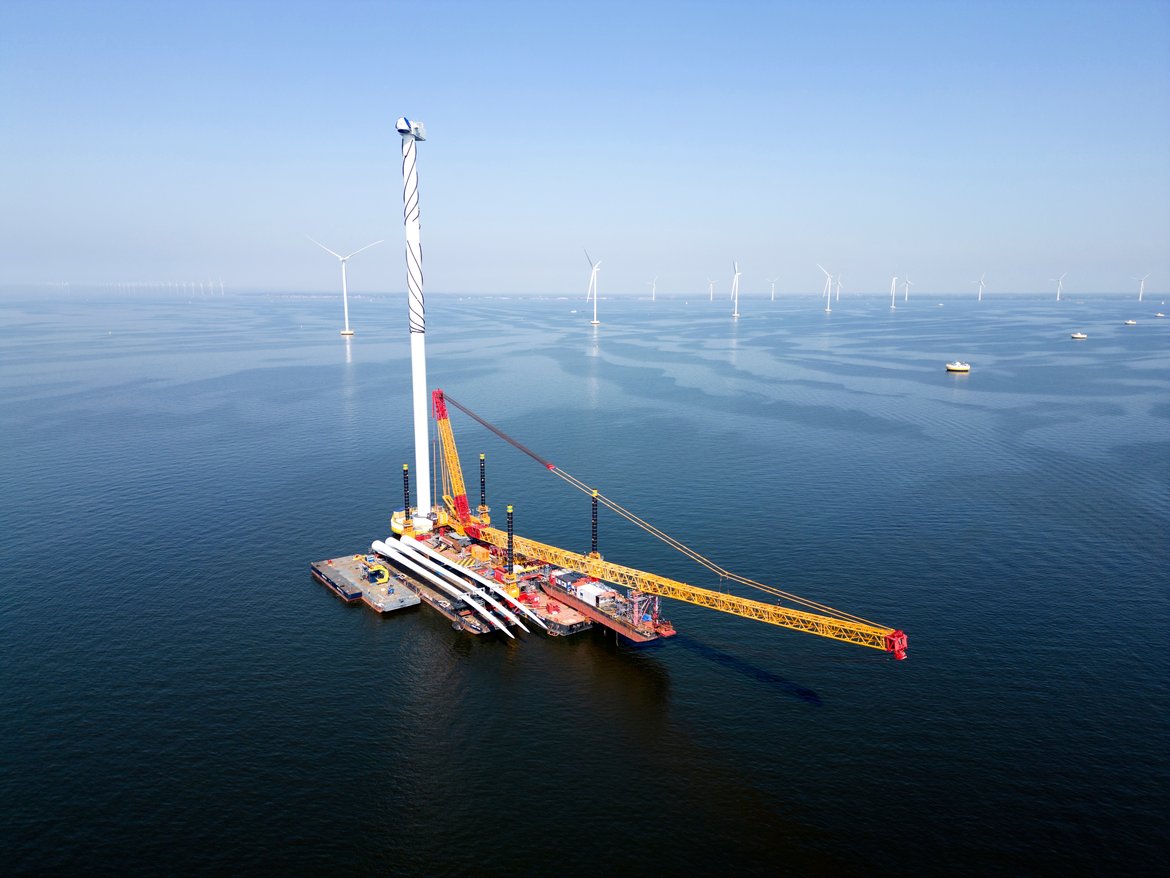
Environmental impacts of developments during the construction phase must be identified and considered.
6.8 The OSPAR database has been updated to include information on offshore renewable energy developments, providing a comprehensive overview of the status and trends in the region (OSPAR, 2023). This database serves as a valuable resource for monitoring the progress of offshore renewable energy projects and assessing their environmental impacts which can sit alongside other portals such as the NSEC’s database and map portal for offshore wind in the North Sea, the Compendium Greater North Sea.
6.9 The European Commission’s guidance document discusses offshore wind developments in the context of the European Birds and Habitats Directives (European Commission, 2020d). It describes the approach to assessing developments which could affect Natura 2000 sites, species protection provisions, and the role of Strategic Environmental Assessment (SEA) and Environmental Impact Assessment (EIA) procedures. It notes that assessment of cumulative environmental impacts is very relevant to wind farm development, particularly in view of the projected expansion in capacity.
6.10 Understanding potential cumulative impacts is nevertheless complex: for example, impacts at population level are poorly understood; the extent of pressures is difficult to evaluate; and data availability can be lacking. The guidance includes recommended approaches for dealing with the challenges of cumulative impacts assessment. It also highlights examples of existing good practice, such as from the Netherlands on cumulative impact assessments, and from the United Kingdom on handling uncertainty in design trends. The role of strategic planning, in the context of the Maritime Spatial Planning Directive and the Marine Strategy Framework Directive, is also emphasised. Wildlife sensitivity maps, such as the seabird mapping and sensitivity tool (SeaMaST) developed for English waters, are also a useful tool.
6.11 While these impact pathways are relatively well characterised at project scale, recent analyses indicate substantial uncertainty in how these pressures translate into ecosystem services outcomes. A global review identified 14 ecosystem services potentially affected by offshore wind farms, yet over 86% of ecosystem service impacts remain classified as unknown (Watson et al 2024). Construction-phase impacts were predominantly negative, whereas operational impacts showed mixed outcomes. Explicit integration of ecosystem service considerations, including wild food provision, cultural values, and regulating services, would strengthen cumulative impact assessment frameworks.
6.12 The Commission’s guidance includes an overview table of potential types of impacts on major offshore receptor groups. This has been augmented with information from Pearson et al (2025) and OCEAN (2024):
| Receptor | Potential impacts of offshore energy developments |
|---|---|
| Ecosystem processes | Changes to primary production and nutrient cycling |
| Altered stratification and mixing regimes | |
| Food-web and trophic cascade effects | |
| Physical processes | Alteration of local wind fields and wake effects |
| Changes to wave climate and wave propagation | |
| Modification of tidal currents and circulation patterns | |
| Changes to water column stratification and vertical mixing | |
| Alteration of sediment transport, erosion and deposition patterns | |
| Changes to suspended particulate matter concentrations | |
| Cumulative basin-scale hydrodynamic modification under high array density | |
| Habitats | Marine habitat loss |
| Marine habitat disturbance and degradation | |
| Smothering from suspended sediments falling out of suspension | |
| Creation of new marine habitats | |
| Changes to physical processes from the presence of new structures | |
| Contaminant release or mobilisation of historic contaminants | |
| Fish | Electromagnetic field effects |
| Underwater noise disturbance | |
| Reef effects | |
| Disruption of spawning and nursery areas | |
| Migration barrier or altered movement pathways | |
| Thermal effects from subsea cables | |
| Cumulative trophic interactions from altered primary production | |
| Birds | Habitat loss and degradation |
| Disturbance and displacement | |
| Collision | |
| Barrier effect | |
| Attraction (e.g. roosting opportunities) | |
| Disorientation from artificial lighting | |
| Population-level cumulative mortality risk | |
| Marine mammals | Habitat loss and degradation |
| Noise disturbance and displacement (pile-driving noise and noise from shipping/helicopters) | |
| Acoustic impairment (injuries from underwater noise) Communication masking | |
| Collision with vessels | |
| Barrier effect | |
| Reduction of fishing pressure (no fishing zones) | |
| Water quality changes (contaminants + marine waste) Electromagnetic field effects on navigation | |
| Reef effect | |
| Chronic operational noise exposure | |
| Indirect effects via altered prey availability | |
| Bats | Disturbance and displacement |
| Collision | |
| Barrier effect | |
| Barotrauma | |
| Loss/shifting of flight corridors and roost sites | |
| Attraction to artificial lighting offshore | |
| Contamination | Microplastic release |
| Corrosion protection by-products | |
| Lubricants and oil | |
| Other species | Noise disturbance and displacement |
| Electromagnetic fields | |
| Heat effects | |
| Creation of new habitats | |
| Facilitation of non-indigenous and invasive species | |
| Water quality changes (contaminants + marine waste) |
6.13 Recent studies have indicated potential systemic effects of large-scale offshore wind deployment in the Southern North Sea. A report by Deltares (2018) indicates that upscaling offshore wind to 2050 could significantly alter the physical functioning of the North Sea, affecting local wind patterns, wave generation, tidal amplitudes, water column stratification, suspended particles, and sediment transport. These physical changes may have cascading ecological consequences, including impacts on primary production, food availability across trophic levels, and habitat suitability. Recent modelling studies reinforce these findings. High-resolution regional climate simulations indicate that large offshore wind farm clusters can reduce near-surface wind speeds by around 1 m s⁻¹ downstream of arrays, alter turbulent mixing and air–sea heat fluxes, and locally cool the lower atmosphere by more than 2 W m⁻², with associated changes in cloud formation and precipitation patterns (Miller et al., 2022). Ecosystem modelling further suggests that wind-farm wake effects may alter marine ecosystem functioning at basin scales, producing local changes in annual primary production of up to ±10% across the North Sea and potentially increasing sediment carbon storage while reducing bottom-water oxygen concentrations in some areas (Daewel et al., 2022). More recent modelling of large offshore wind build-out scenarios indicates that dense clusters of turbines may modify regional circulation and current velocities, reinforcing the potential for system-scale hydrodynamic and ecological responses as deployment expands (Christiansen at eal, 2026). Broader knowledge gap analyses identify cumulative hydrodynamic modification and trophic-level responses as priority areas for further research, particularly as array density increases (Pearson et al 2025).
6.14 The European Commission's guidance on wind energy developments (European Commission 2023c) emphasises the need for mitigation measures to address potential environmental impacts. It recommends appropriate siting of wind installations to avoid impacts on protected habitats and species, and the use of the least disturbing methods for activities such as cable installations. The creation of artificial reef habitats on the foundations of structures can affect biodiversity, particularly in areas without natural rock habitats. While this can increase the biodiversity of benthic habitats, it also affects local community structure and may facilitate the establishment of non-indigenous species. Offshore wind foundations and associated scour protection may function as artificial reefs, increasing local biomass and providing hard substrate in predominantly soft-sediment environments. However, changes in community composition, facilitation of non-indigenous species, and uncertain long-term ecosystem functioning remain concerns (Pearson et al 2025). Nature-inclusive design approaches, including eco-engineered scour protection, are being explored but require robust monitoring to determine that they are contributing a positive ecological benefit in line with either project level targets or broader ecosystem recovery objectives rather than localised habitat modification.
6.15 The Commission also notes the need to consider the potential impacts of noise from offshore wind developments on fish and marine mammals, particularly impulsive noise from pile driving during foundation installation. Impacts may include physical effects, such as hearing damage, and behavioural effects, such as displacement from preferred habitats. Emerging evidence further indicates that impulsive noise may induce physiological stress responses in invertebrates, including metabolic disruption and potential reproductive effects, though these remain insufficiently studied (Pearson et al 2025) Increased noise levels from the operation of wind developments, such as maintenance vessel movements, may also have negative impacts. Mitigation measures include appropriate siting of developments, scheduling of activities to avoid sensitive periods, engineering and surveillance approaches to reduce noise impacts, and the use of deterrents, though deterrent devices may themselves contribute to cumulative acoustic pressure if not carefully managed (OCEaN 2024).
6.16 For birds, the most successful way to reduce impact is to avoid siting wind farms in foraging areas, which is most successfully done at the planning stage. Once project areas have been agreed and projects are going through consenting, mitigation measures include designing infrastructure to reduce collision risk, scheduling activities to avoid disturbance during sensitive periods, using acoustic or visual deterrents and adaptive curtailment strategies, such as seasonal shutdowns, migration model-informed curtailment, and radar- or camera-triggered shutdown-on-demand systems (OCEaN 2024). While these approaches can reduce collision risk, their effectiveness in offshore contexts remains under evaluation, and trade-offs with energy yield and grid stability must be considered.
6.17 A recent review of chemical emissions associated with offshore wind farms identifies chemical release as an under-assessed pressure relative to noise and habitat change (Hengstmann et al., 2025). The study compiled 228 potential emission substances across 13 source categories, with coatings, corrosion protection systems and operational fluids representing the most significant contributors. Emissions may occur continuously through material leaching, intermittently during maintenance activities, or accidentally through spills or system failures. While many releases are expected to be localised, the diversity of substances and persistence of certain compounds raise questions regarding long-term and cumulative exposure, particularly under large-scale deployment scenarios.
6.18 The review emphasises that comprehensive monitoring of all potential substances is impractical and recommends a risk-based prioritisation approach focused on emission likelihood, persistence, toxicity and bioaccumulation potential. It highlights the need for harmonised monitoring methodologies, including a combination of targeted and non-target screening approaches, as well as passive sampling techniques to capture time-integrated exposure. The authors conclude that improved disclosure of materials, clearer regulatory frameworks and coordinated monitoring across projects are necessary to enable cumulative chemical risk assessment and management at regional scale (Hengstmann et al., 2025).
Impacts and measures – tidal and wave energy
6.19 Tidal and wave energy devices can influence local and regional hydrodynamics by extracting energy from marine systems (ICES, 2019; ICES, 2024). Significant alterations are more likely with large-scale installations exceeding 1,5 GW (ICES, 2019). Regional hydrodynamic models are valuable tools for assessing potential impacts; however, inherent uncertainties necessitate ongoing environmental monitoring to inform adaptive management strategies (ICES, 2024).
6.20 Developments in tidal and wave energy can affect seabed dynamics, influencing erosion and deposition patterns along coastlines and offshore sandbanks (ICES, 2024). Large-scale projects have a higher potential to induce significant changes, but even localized installations may cause localised scouring or alterations in bathymetry (ICES, 2019; ICES, 2024). Continuous monitoring is essential to detect such impacts and inform mitigation measures (ICES, 2024).
6.21 ICES advises that the environmental effects of tidal and wave energy installations on marine life, including benthic communities, fish, birds, and marine mammals, require further investigation (ICES, 2019; ICES, 2024). Recent evidence syntheses similarly highlight limited empirical evidence for floating and non-fixed technologies compared with bottom-fixed offshore wind (Pearson et al 2025, EMB 2023). While some changes are expected to be site-specific, broader ecological effects may arise, particularly from large-scale projects (ICES, 2024). Potential benefits for benthic habitats can be achieved through thoughtful infrastructure design and the exclusion of bottom fishing activities. However, the colonization of structures by non-indigenous species remains a concern (ICES, 2019).
6.22 The siting of tidal and wave energy structures should avoid critical habitats such as nursery zones, spawning grounds, and migration routes (ICES, 2019; ICES, 2024). Potential impacts include alterations to food webs, collision risks, effects of electromagnetic fields from cables, and behavioural responses to noise (ICES, 2024). These effects necessitate further research and monitoring to understand and mitigate potential risks (ICES, 2019; ICES, 2024).
6.23 ICES underscores the importance of strategic research and monitoring to enhance understanding of the cumulative impacts of tidal and wave energy developments (ICES, 2019; ICES, 2024). This includes the development of guidance and methodologies for cumulative impact assessments and the evaluation of decommissioning options. Additionally, the potential effects of emerging technologies, such as floating solar and Ocean Thermal Energy Conversion (OTEC), should be kept under review (ICES, 2024; Copping et al, 2025).
Floating Solar
6.24 Floating solar photovoltaic (FPV) systems in marine and offshore contexts represent an emerging renewable energy technology with significant potential but substantial environmental and technical uncertainties. The transition from freshwater to marine deployment introduces added complexity, including corrosion, wave and wind loading, mooring reliability, and long-term durability challenges (Djalab et al. (2024), Oliveira-Pinto (2020), Fan et al. (2025), Shi et al. (2023)), with limited operational data available to validate long-term performance in exposed offshore conditions.
6.25 Environmental and ecological impacts remain comparatively under-researched relative to technical considerations. Key environmental pathways include shading effects that reduce light penetration and potentially alter primary production and benthic communities (Benjamins et al. (2024), Pouran et al. (2022), Exley et al. (2021)); modifications to hydrodynamics, sediment transport, and water-atmosphere exchange processes (Benjamins et al. (2024), Hooper et al. (2021)); and potential changes to water quality, temperature, and nutrient cycling (Pouran et al. (2022)). Ecologically, floating structures may create artificial reef effects that attract some species while displacing others (Benjamins et al. (2024), Exley et al. (2021)), and may influence fish, seabirds, and marine mammals through habitat alteration, movement barriers, collision risk, and mooring interactions Benjamins et al. (2024). The literature repeatedly emphasises the lack of long-term empirical monitoring in marine settings and the need for standardised environmental impact assessment and monitoring protocols specific to FPV systems (Benjamins et al. (2024), Pouran et al. (2022), Exley et al. (2021)).
Cumulative effects
6.26 The rapid expansion of offshore wind across the OSPAR Maritime Area requires cumulative effects assessment (CEA) to operate at a regional sea scale, consistent with OSPAR’s ecosystem approach and commitments under the Marine Strategy Framework Directive (MSFD) and the Maritime Spatial Planning Directive. Whilst cumulative effects are routinely referenced in project-level EIAs, methodological inconsistency and lack of defined significance thresholds continue to limit their effectiveness (Willsteed et al., 2018; Gill et al., 2022). Structured frameworks such as DPSIR-based approaches provide more systematic pathways for linking drivers, pressures and ecological receptors (Platteeuw et al., 2017), while risk-based prioritisation tools demonstrate how cumulative pathways can be screened and linked directly to spatial planning decisions (Brignon et al., 2022). For OSPAR, this suggests that there may be a need to harmonise core assessment principles across Contracting Parties while retaining flexibility for national implementation.
6.27 Regional-scale spatial modelling is increasingly recognised as essential to management of cumulative effects. Basin-wide analyses of the North Sea demonstrate distinct spatial hotspots and temporal peaks in cumulative pressure, with operational impacts accounting for a substantial proportion of total effects over time (Gușatu et al., 2021a; Gușatu et al., 2021b). These findings reinforce the importance of lifecycle-based assessment embedded within MSP processes rather than construction-focused evaluation. Within an OSPAR context, such approaches align with the need for coordinated regional data platforms and shared modelling tools capable of assessing cross-border cumulative effects, particularly in intensively developed sub-regions such as the Greater North Sea.
6.28 Receptor-specific studies highlight where cumulative pressures may affect Good Environmental Status objectives. Collision and displacement modelling for seabirds indicates potential population-level consequences under high-density deployment scenarios (Brabant et al., 2015; Peschko et al., 2024), while cumulative underwater noise and habitat exclusion pressures require precautionary controls to protect marine mammals (Platteeuw et al., 2017). For demersal fish communities, cumulative offshore wind expansion interacts with fisheries redistribution and climate change, with warming projected to be a dominant driver of ecosystem transformation by mid-century (Rehren et al., 2025). These findings emphasise that cumulative assessment under OSPAR must integrate offshore renewables within a broader multi-pressure context, consistent with ecosystem-based management.
6.29 Project-by-project mitigation and compensation measures are unlikely to be sufficient in heavily developed basins (Kuderer, 2022; Kuderer, 2023). Effective cumulative mitigation requires integration into MSP, comparison of pressures across sectors, and explicit evaluation of trade-offs (van der Wal et al., 2014; Stelzenmüller et al., 2021; Trifonova et al., 2025). Within OSPAR, this implies strengthening regional coordination mechanisms, aligning cumulative assessment methodologies, and embedding avoidance and strategic spatial allocation as primary mitigation tools. Monitoring programmes must also operate at scales capable of detecting population-level and ecosystem responses, supported by adaptive management frameworks that enable periodic review of cumulative thresholds and management measures (Gill et al., 2022; Trifonova et al., 2022).
6.30 Cumulative effects governance in the OSPAR region should move from reactive aggregation of project assessments toward proactive, regionally coordinated planning supported by spatial modelling, ecosystem-based assessment tools and long-term monitoring. This shift will be helpful if offshore renewable expansion should remain compatible with biodiversity objectives and the achievement of Good Environmental Status across the OSPAR Maritime Area.
Measure implementation
6.31 Recent synthesis work emphasises that mitigation for offshore renewable energy must move beyond reactive, project-by-project measures toward a structured, mitigation hierarchy-led approach embedded at strategic scale. Over 80 avoidance and minimisation measures have been identified as applicable across planning, construction, operation and decommissioning phases (OCEaN, 2024). The most effective mitigation occurs upstream, through SEA-informed Maritime Spatial Planning (MSP), early constraint mapping, and strategic site selection. Avoidance of biodiversity-rich and functionally critical areas, including migratory corridors, spawning grounds, nursery areas, stratified waters and sensitive benthic habitats, remains the single most powerful mitigation tool (OCEaN, 2024, European Marine Board, 2024).
6.32 At the project scale, mitigation measures are increasingly well developed but unevenly implemented. Best-practice approaches including: micro-siting informed by high-resolution ecological data; seasonal timing restrictions; low-noise installation techniques; use of double bubble curtains and alternative foundation methods; adaptive lighting design to reduce attraction and disorientation; cable burial and shielding to reduce EMF exposure; and nature-inclusive design approaches (OCEaN, 2024). It should be noted that many mitigation measures remain insufficiently tested in offshore contexts, particularly in relation to behavioural responses, long-term displacement, and ecosystem service impacts (Watson et al. 2024). There should be a distinction made between well-established mitigation measures and those still in conceptual or pilot phases, and adaptive management should be emphasised as a core principle rather than a residual consideration.
6.33 Mitigation should also explicitly address cumulative effects. However, cumulative effects assessment (CEA) requires consistent baselines, clarity of purpose, and integration into marine planning processes rather than ad hoc aggregation of project EIAs (Willsteed, Collin & Koehler, 2024). Risk-based CEA frameworks and DPSIR-type approaches are identified as particularly suitable where data gaps persist. For example, informed curtailment, and construction phasing across regions, supported by coordinated monitoring programmes and shared data platforms can act as cumulative mitigation tools at basin scale.
6.34 It is important to move beyond simple impact minimisation toward nature-inclusive and restorative approaches. While restoration and compensation fall outside the strict “avoid and minimise” scope of mitigation hierarchy, integrating habitat enhancement, artificial reef optimisation, and exclusion-zone fisheries recovery effects into design thinking may reduce net ecological pressure (OCEAN 2024). Mitigation effectiveness depends not only on technological solutions, but on governance coordination, cross-border cooperation, long-term monitoring, and iterative plan review.
Decommissioning
6.35 As offshore wind farms approach end-of-life, decommissioning is increasingly being considered as both a strategic environmental decision and a technical compliance requirement. The offshore wind decommissioning literature identifies three principal pathways: complete removal, partial removal and in situ retention (Smyth et al., 2015; Jadali et al., 2021; Rouse et al., 2022). Under OSPAR Decision 98/3, complete removal of disused offshore installations (pertaining to oil and gas) is the default position in the North-East Atlantic, with derogations being able to be considered for certain categories with an aspiration to reducing derogation proposals.
6.36 OSPAR has committed to develop an updated approach on decommissioning of offshore renewable energy installations by 2027 (Agreement 2025-01) based on available evidence and stakeholder consultation. Whilst full removal is the current de facto position, it must be recognised that it also introduces additional environmental pressures that must be evaluated, including sediment disturbance, turbidity generation, acoustic disturbance and lifecycle greenhouse gas emissions associated with extraction operations (Stranddorf et al. (2024), Mooney et al. (2020)).
Monitoring
6.37 Efforts to improve evidence for decision-making on offshore wind developments are being addressed through various monitoring and research programs. In Belgium, the WinMon.BE program has been monitoring environmental impacts since 2019, with results published in 2023 (Degraer et al., 2023). In the Netherlands, the Noordzeeloket initiative provides a platform for research and data sharing related to offshore wind energy (Noordzeeloket, 2024). In Germany, the Federal Maritime and Hydrographic Agency (BSH) has established legally binding “Standard Investigation of the Impacts of Offshore Wind Turbines on the Marine Environment” requirements, which set out detailed and standardised pre-construction, construction and operational monitoring protocols for offshore wind projects (BSH, 2013, as amended). This approach provides a harmonised, science-based framework for baseline surveys, impact monitoring and data comparability across projects, thereby supporting cumulative assessment and regional-scale evaluation of environmental effects.
6.38 In the United Kingdom, The Crown Estate's Offshore Wind Evidence and Change (OWEC) Programme, launched in 2020 with over £50 million in funding, aims to provide essential insights to help the sector better understand and address cumulative environmental impacts and interactions with other industries and activities (The Crown Estate, 2020). Additionally, the UK Government's Offshore Wind Strategic Monitoring and Research Forum (OWSMRF) coordinates research efforts to support the sustainable development of offshore wind (JNCC, 2024). Work exploring the use of Bow Tie Analysis in the context of ecosystem services to assist decision-making in OSPAR has also been carried out (Rijkswaterstaat, 2020). Monitoring programmes should be designed to address cumulative and long-term ecosystem change, rather than solely project-specific compliance requirements. Harmonisation of methodologies across OSPAR Contracting Parties would enhance comparability and improve regional-scale understanding.
Evidence Gaps
7.1 This section summarises evidence gaps identified across recent literature for offshore wind, tidal and wave energy, as well as work done by JNCC in the UK to inform planning of the Offshore Wind Evidence and Change programme priority funding recommendations (Mogensen et al., 2022). The focus is on gaps that directly constrain consenting, cumulative assessment, strategic planning and ecological risk evaluation at population and ecosystem scales.
Offshore wind energy gaps
7.2 Cumulative assessment and regional-scale forecasting: Cumulative impact assessment practice remains inconsistent and frequently fails to meet decision-maker needs, particularly under accelerated build-out scenarios (Gușatu et al., 2021). Agreed methodologies, standardised scenarios and shared baselines for spatial–temporal modelling remain limited. The UK’s Joint Nature Conservation Committee (JNCC) similarly identifies cumulative assessment capability as a high priority theme, particularly for seabirds where large-scale displacement and collision risks require integrated modelling across projects (Mogensen et al., 2022). Without harmonised methods and transparent scenario assumptions, MSP and SEA outputs remain difficult to compare and defend.
7.3 Monitoring standardisation and data quality: There remains heavy reliance on heterogeneous, often grey literature sources in EIA, with variable transparency and limited transferability (Szostek et al., 2024). JNCC highlights the need for refreshed baseline at-sea seabird distribution data, improved essential fish habitat mapping, and standardised monitoring protocols that enable regional meta-analysis (Mogensen et al., 2022). Short-term, site-specific baselines dominate, limiting the ability to distinguish development signals from natural variability (Chapman et al., 2024). Harmonised metadata standards and interoperable repositories are necessary to enable cumulative analysis and improve evidence provenance.
7.4 Population and ecosystem-level inference: While local ecological effects are increasingly documented, translation to demographic rates and population trajectories remains weak (Knorrn et al., 2024). JNCC identifies displacement consequences for seabirds, collision risk modelling inputs (flight height, avoidance rates), and prey availability changes as critical uncertainties limiting population-level appraisal (Mogensen et al., 2022). For marine mammals, key gaps include responses to operational turbines, chronic noise exposure, and the causes and consequences of hearing effects, as well as evaluation of mitigation effectiveness (Mogensen et al., 2022). Without linking behavioural responses to vital rates, conservation risk remains uncertain.
7.5 Benthic and decommissioning evidence: Introduced hard substrates (scour and cable protection) represent a priority benthic knowledge gap. JNCC identifies the ecological functioning beneath protection materials, the consequences of removal during decommissioning, and development of nature-based cable protection solutions as evidence priorities (Mogensen et al., 2022). These themes align with broader uncertainty regarding artificial reef effects, invasive species risk, and net outcomes under alternative decommissioning scenarios.
7.6 Electromagnetic fields and subsea cables: Potential biological effects of EMF remain repeatedly flagged across literature (Knorrn et al., 2024). JNCC identifies EMF effects on electrosensitive and migratory fish as a specific priority area, particularly for informing proportionate mitigation thresholds and cable burial requirements (Mogensen et al., 2022). Empirical, ecologically scaled field studies remain insufficient to define exposure–response relationships.
Tidal energy gaps
7.7 Hydrodynamic–ecological process integration: There is insufficient empirical integration between high-resolution hydrodynamic change, residual circulation shifts and downstream ecological effects such as larval dispersal and prey field dynamics (De Dominicis et al., 2022). Without linking physical process modification to trophic outcomes, assessment risks underestimating far-field or cumulative impacts. This scale mismatch mirrors concerns raised in offshore wind monitoring design (Chapman et al., 2024).
7.8 Population-level responses for mobile fauna: Evidence quantifying seabird, fish and marine mammal population responses to tidal extraction, collision risk and disturbance remains limited (De Dominicis et al., 2022). JNCC’s emphasis on essential fish habitat mapping and improved migratory route understanding is directly relevant here (Mogensen et al., 2022), as tidal arrays may overlap with dynamic migratory corridors.
Wave energy gaps
7.9 Site-specific ecological prediction: Modelling suggests ecological responses to wave energy extraction are strongly location dependent and often smaller than climate-driven change (Want et al., 2024), yet predictive capacity across sites remains limited. Transferability of findings between device types and hydrodynamic regimes is weak.
7.10 Device type, density and age effects: Empirical data on colonisation patterns, fisheries interactions and disturbance across different device types and deployment densities remain sparse (Knorrn et al., 2024). As with offshore wind, lifecycle and density scaling effects require improved monitoring integration.
Critical cross-cutting knowledge gaps
7.11 Regional cumulative governance: Regional multi-project cumulative assessments lack standardised inputs, agreed future scenarios and transparent methods (Gușatu et al., 2021). JNCC explicitly identifies cumulative modelling and regional coordination as necessary to reduce consenting risk and avoid fragmented decision-making (Mogensen et al., 2022). Without regionally harmonised frameworks, SEA and MSP outputs risk inconsistency and reduced strategic value.
7.12 Monitoring design and process driven monitoring: Current EIA/HRA practice often under-represents underlying physical drivers and trophic linkages (Chapman et al., 2024). Process-driven monitoring integrating hydrodynamic sensors, prey field surveys and predator–prey linkage metrics within national monitoring programmes is required to reduce uncertainty and improve adaptive management. JNCC similarly stresses that evidence investment should prioritise uncertainty reduction directly linked to consenting bottlenecks (Mogensen et al., 2022).
7.13 Population connectivity and demographic linkage: Few studies connect behavioural change to survival, fecundity or metapopulation connectivity (De Dominicis et al., 2022). This gap undermines confidence in cumulative ecological risk appraisal and complicates application of the precautionary principle.
7.14 Data accessibility and provenance: Inconsistent use of grey versus primary literature and limited data sharing constrain transparency and meta-analysis (Szostek et al., 2024). JNCC highlights the need for coordinated evidence platforms and structured evidence registers to reduce duplication and accelerate learning (Mogensen et al., 2022).
Conclusion
Key messages1
8.1 Offshore wind has become a dominant and rapidly expanding use of coastal and shelf seas in the OSPAR Maritime Area, with installed capacity in Europe reaching approximately 36,7 GW by the end of 2024, a significant increase from ~22 GW in 2019. This expansion is driven by ambitious targets, such as the North Sea countries' plan for ~120 GW by 2030 and ~300 GW by 2050.
8.2 The development of floating wind technology has progressed from demonstration projects to early commercial scale in OSPAR waters, with significant operational capacity in Norway, the United Kingdom, France, Portugal, and Spain. Projections indicate Europe may reach 1 GW of floating capacity by 2030.
8.3 Despite its rapid growth, the expansion of offshore renewable energy faces challenges related to effective maritime spatial planning, ensuring coexistence with other sea uses, and compliance with environmental legislation. Permitting delays, auction design, supply chain limits, and grid integration constraints could be critical bottlenecks that may slow deployment below the highest projected scenarios.
8.4 Potentially significant environmental pressures arise from offshore renewable energy developments, including physical loss and disturbance of habitats, noise pollution (both impulsive and continuous), collision risks for birds and bats. There is particular concern regarding the cumulative and systemic effects of large-scale deployment. Project-level Environmental Impact Assessment (EIA) processes are well established; however, the ability to predict basin-scale outcomes, including hydrodynamic modification, trophic interactions, population-level seabird displacement and long-term chemical exposure, remains comparatively underdeveloped. Recent studies indicate that under high-density deployment scenarios, large-scale offshore wind development in the Southern North Sea could potentially significantly alter its physical functioning, affecting wind fields, wave generation, stratification, tidal amplitudes and sediment transport, with cascading ecological consequences.
8.5 Tidal, wave power and floating offshore solar remain in earlier stages of development compared to offshore wind, with operational projects being small-scale or demonstration-level. While they hold significant resource potential, challenges include device survivability, reliability in harsh sea states, environmental impact uncertainty, grid connection costs, and financing barriers. Evidence limitations are particularly acute for tidal and wave technologies, where process linkages between hydrodynamic alteration and ecological outcomes remain insufficiently quantified at population or ecosystem scales.
8.6 OSPAR and the European Union have implemented various measures to promote sustainable development and minimise environmental impacts. OSPAR has developed guidance and principles for offshore wind farm development and established an Intersessional Correspondence Group on Offshore Renewable Energy Developments (ICG-ORED). EU strategies and guidance emphasise strategic environmental assessment (SEA), environmental impact assessment (EIA), and the need for comprehensive monitoring, data exchange, and adaptive management.
8.7 There is a continuing need for harmonised, long-term and process-driven monitoring to address persistent knowledge gaps. Short-term, site-specific baselines are insufficient to resolve cumulative, climate-interacting or population-level effects. Priority evidence gaps to inform future mitigation and monitoring include seabird displacement consequences and collision modelling inputs; operational turbine responses and chronic noise exposure in marine mammals; essential fish habitat and migratory connectivity; electromagnetic field exposure thresholds; benthic functioning of scour and cable protection; and decommissioning outcomes. Addressing these themes would materially reduce consenting uncertainty.
Distribution and intensity of activity
8.8 Offshore wind has firmly established itself as a dominant and rapidly expanding use within the OSPAR Maritime Area, with development primarily concentrated in the Greater North Sea (Region II) and Celtic Seas (Region III) sub-regions. Europe had approximately 36,7 GW of installed offshore wind capacity by the end of 2024. Key OSPAR countries anchoring deployed capacity include the United Kingdom (~15 GW+), Germany (~9.7 GW), the Netherlands (~4,7 GW), Denmark (~2,3 GW), and Belgium (~2,26 GW), with France now adding its first gigawatt-scale projects (~1,5 GW operational). The Atlantic margin (Iberian–French–Irish–Norwegian coasts) offers deep-water resources suited to floating technology. Floating wind capacity, totalling ~231 MW by end-2024, is operational across Norway (101 MW), the United Kingdom (78 MW), France (27 MW), Portugal (25 MW), and Spain (7 MW, 5 of which are located in the Canary Islands).
8.9 For tidal and wave power, the Atlantic Ocean has good natural potential. In tidal stream energy, the United Kingdom has the largest level of deployment with test centres and commercial sites, while operational or planned developments also exist in France, Belgium, the Netherlands, Norway, and Spain. The MeyGen tidal stream project in Scotland is the largest operational array in the OSPAR Maritime Area at 6 MW. For wave energy, the United Kingdom, Ireland, and Norway are best suited, followed by northern Spain, France, and Portugal. A coastline infrastructure energy plant of ~300 kW remains operational in northern Spain.
8.10 There is potential for floating solar in the OSPAR area, and that there are pilots taking place inside and outside of offshore windfarm areas, particularly in the Netherlands.
Trends
8.11 Offshore wind capacity in Europe has shown a rapid upward trend, growing from ~22 GW in 2019 to ~36,7 GW by mid-2025. Globally, installed offshore wind reached ~83 GW by end-2024, though Europe's share has decreased as other regions, particularly China, accelerated. Over this period, the average rated capacity of offshore wind turbines, the size of wind farms, and the distance to shore have all continued to grow, with 14–15 MW prototypes being deployed and 16–18 MW turbines expected between 2025 and 2026.
8.12 Floating offshore wind has transitioned from pilot to early commercial scale, with capacity growing from 45 MW in 2019 to ~250 MW by mid-2025, and projections for Europe to reach 1 GW by 2030.
8.13 Tidal and wave energy installations remain small but are showing a movement from demonstration to growing pre-commercial pipelines. Total operational wave energy in the OSPAR Maritime Area is minimal (~1,12 MW), though ~20 MW is consented or in planning. Technology trends for tidal devices show a movement towards lighter, floating, and semi-floating concepts. Factors that could increase future development opportunities include improved marine spatial planning tools, stronger evidence on environmental interactions, and revenue-support instruments. However, persistent barriers include device survivability, reliability, grid-connection costs, and constrained investment conditions.
8.14 Looking ahead, a further major expansion of offshore renewable energy is anticipated, primarily offshore wind, but also involving tidal and wave power which are in a pre-commercial deployment phase, and more novel technologies such as marine floating solar and green hydrogen production which are at pilot and feasibility testing phase. The EU collectively aims for 109–112 GW by 2030 and 281–317 GW by 2050, with North Sea countries targeting ~120 GW by 2030 and ~300 GW by 2050. Specific national plans detail significant growth, for example, the United Kingdom's ambition of ~43–50 GW by 2030, and Norway's target of 30 GW by 2040. Co-location opportunities with other marine uses, such as offshore shellfish culture, are also being investigated.
Economic value
8.15 The offshore wind energy sector within the EU has demonstrated strong economic growth, with employment reaching 17 300 people in 2022 (estimated 18400 for 2023) and average wages rising to €72 100. Gross Value Added (GVA) grew to €5,3 billion in 2022, and profits rose to €4,1 billion. The wider supply chain for offshore wind creates substantial employment beyond coastal regions, with the United Kingdom wind industry supporting 55 000 jobs, approximately 40 000 of which are in offshore wind.
8.16 Economic activity in tidal and wave energy, while smaller than offshore wind, is growing, with pilot and demonstration projects increasing and employment projected to rise as pre-commercial farms come online. Floating solar is currently behind tidal and wave energy in terms of technical readiness and as such there is limited robust information on the potential value of this market. OSPAR countries continue to lead globally in offshore renewable technologies, with Europe holding a strong position in fixed-bottom and floating wind, and strong export positions for equipment and services. Major investment continues to support offshore renewable ambitions, with the European Commission projecting up to €800 billion in investment to meet 2050 targets. The UK government anticipates £20–30 billion in additional private investment by 2030, with GB Energy projected to unlock a further £60 billion.
Pressures and impacts
8.17 The substantial growth of offshore renewable energy introduces several environmental pressures and impacts on the marine environment. These include:
- Physical Loss and Disturbance: Permanent changes to seabed substrate and morphology, as well as temporary disturbances during construction and operation. This can influence local and regional hydrodynamics, affecting erosion and deposition patterns.
- Noise Pollution: Both impulsive noise from pile driving during installation and continuous operational noise and noise related to vessel operations can affect marine mammals and other marine life, leading to physical effects like hearing damage or behavioural effects such as displacement.
- Collision Risks: Potential for birds and bats to collide with turbine structures.
- Electromagnetic Fields (EMFs): From subsea cables, which may impact marine species sensitive to magnetic fields.
- Light and Heat Emissions: From turbines and associated infrastructure, potentially affecting marine organisms, as well as migrating birds and bats.
- Disturbance: Displacement of seabirds from their feeding and resting areas.
- Cumulative and systemic effects: Multiple overlapping pressures, including habitat modification, noise, hydrodynamic alteration and chemical exposure, may interact spatially and temporally. Without harmonised regional assessment frameworks and shared scenario modelling, cumulative impacts on biodiversity and ecosystem services cannot be reliably predicted. Basin-scale hydrodynamic modification in the Southern North Sea may influence primary production and food-web dynamics.
- Non-indigenous species: The creation of artificial reef habitats on structures can facilitate the establishment of non-indigenous species.
- Chemical emissions: Leaching from coatings, corrosion protection systems and operational fluids represents an under-assessed but potentially persistent pressure. While effects are likely localised at project scale, cumulative exposure under high-density deployment remains uncertain and requires risk-based monitoring approaches.
- For tidal and wave energy, specific environmental effects on marine life, including benthic communities, fish, birds, and marine mammals, require further investigation. Potential impacts include alterations to food webs, and the colonization of structures by non-indigenous species remains a concern.
Measures
8.18 A range of measures are being implemented to understand and manage the environmental impacts of offshore renewable energy development. OSPAR has produced guidance on environmental considerations for offshore wind farm development since 2008 (Agreement 2008-03) and established the Intersessional Correspondence Group on Offshore Renewable Energy Developments (ICG-ORED) in 2021 to develop common principles and guidance for sustainable development and minimisation of cumulative environmental impacts. OSPAR also maintains a database of marine renewable developments.
8.19 The European Commission's Offshore Renewable Energy Strategy (2020) and subsequent communications (2023) acknowledge the need for comprehensive monitoring, scientific research, data exchange, and modelling tools to assess cumulative effects. The Commission has also published revised guidance on wind energy developments and EU nature legislation, emphasising compliance with environmental protection standards. This guidance highlights the importance of Strategic Environmental Assessment (SEA) and Environmental Impact Assessment (EIA) procedures, particularly for assessing cumulative environmental impacts, and recommends approaches for dealing with the challenges of cumulative impacts assessment. This focus has changed recently with the adoption of RED III by the EU. Under the RED III framework EU Member States are mandated to designate ' renewable acceleration areas' where renewable projects with low environmental risk receive fast-tracked permitting with shorter simplified EIA and capped permitting timelines (2 years for offshore projects)
8.20 Cumulative assessment methodologies remain heterogeneous across Contracting Parties. Harmonisation of modelling assumptions, monitoring protocols and data accessibility is required to improve comparability and strengthen Strategic Environmental Assessment outputs at regional scale.
8.21 Experts at the 2025 Conference on Wind Energy and Wildlife Impacts highlighted that limited availability, accessibility, and interoperability of environmental data, particularly metadata from EIA, remain a major barrier to robust cumulative assessment. Developing a coordinated strategy for data exchange and accessibility was identified as a key priority to improve evidence-based decision making. Furthermore, under the new RED III framework and the designation of acceleration areas, the volume of available EIA data is expected to decrease in some OSPAR member states, (Article 16a(3) Directive EU/2023/2413), potentially compounding these challenges and reinforcing the need for transparent, data-sharing mechanisms . Reduced availability of EIA data may further constrain cumulative analysis unless compensatory regional data-sharing platforms are developed.
8.22 Mitigation effectiveness, particularly for continuous operational noise, collision reduction technologies and electromagnetic field exposure, remains unevenly evidenced and requires further empirical validation at scale. Mitigation measures include:
- Appropriate siting of installations to avoid protected habitats and species, and using the least disturbing methods for activities such as cable installations.
- Scheduling activities to avoid sensitive periods, designing infrastructure to reduce collision risk, and using acoustic or visual deterrents.
- Engineering and surveillance approaches to reduce noise impacts from pile driving and operational activities.
8.23 The creation of artificial reef habitats on foundations, while benefiting benthic biodiversity, also requires consideration of potential impacts on local community structure and the establishment of non-indigenous species.
8.24 Monitoring and research programs are underway to improve evidence for decision-making. Examples include Belgium's WinMon.BE program, the Netherlands' Noordzeeloket initiative, and the United Kingdom's Offshore Wind Evidence and Change (OWEC) Programme and the Offshore Wind Strategic Monitoring and Research Forum (OWSMRF). For wet renewables, ICES advises on the importance of regional hydrodynamic models, continuous environmental monitoring, and strategic research to enhance understanding of cumulative impacts and evaluate decommissioning options. The siting of tidal and wave energy structures should avoid critical habitats like nursery zones, spawning grounds, and migration routes. While these initiatives represent substantial progress, interoperability of datasets and comparability of monitoring designs remain limited, constraining their contribution to cumulative regional assessment.
Regional Summary
8.25 Offshore renewable energy generation in the OSPAR Maritime Area is primarily concentrated in the Greater North Sea and Celtic Seas sub-regions. The United Kingdom leads in deployed offshore wind capacity (~15 GW+), followed by Germany (~9.7 GW), the Netherlands (~4,7 GW), Denmark (~2,3 GW), and Belgium (~2,26 GW). France has recently added its first gigawatt-scale projects, reaching ~1,5 GW.
8.26 In terms of floating offshore wind, Norway holds the largest operational capacity (101 MW), followed by the United Kingdom (78 MW), France (27 MW), Portugal (25 MW), and Spain (7 MW, 5 of which are located in the Canary Islands just outside of the OSPAR Maritime Area). For tidal stream energy, the United Kingdom has the largest deployment level, including the 6 MW MeyGen project in Scotland, with other developments in France, Belgium, the Netherlands, Norway, and Spain. Wave energy projects are mainly small-scale demonstrations, with a 300 kW plant operational in northern Spain.
8.27 Regional ambitions for offshore wind are high, particularly in the North Sea, with NSEC setting aggressive regional targets. Countries like Germany, the Netherlands, Belgium, Denmark, France, Ireland, and Norway all have significant national plans for expansion
Governance implications and strategic coordination
8.28 The scale and pace of offshore renewable energy deployment across the OSPAR Maritime Area mean that governance challenges are increasingly regional and cumulative rather than project specific. While Environmental Impact Assessment (EIA) and Strategic Environmental Assessment (SEA) frameworks are well established, their consistent application to large-scale, multi-project and cross-border scenarios remains uneven. As build-out accelerates toward 2030 and 2050 targets, greater harmonisation of cumulative assessment methodologies, shared development scenarios and transparent modelling assumptions will be essential to avoid fragmented consenting outcomes and under-recognised systemic effects.
8.29 A central priority is the development of interoperable, process-driven monitoring frameworks. Short-term, site-specific surveys are insufficient to resolve cumulative, climate-interacting or population-level impacts. OSPAR is well placed to promote common monitoring protocols, metadata standards and regional data-sharing platforms that improve comparability and enable meta-analysis. Enhanced accessibility of environmental data, particularly in light of evolving regulatory frameworks and acceleration areas, will be critical to maintaining transparency and evidence-based decision-making.
8.30 Ultimately, offshore renewable energy is becoming a structural feature of the OSPAR maritime space. The strategic challenge is not solely to facilitate deployment, but to ensure that cumulative, cross-border and long-term environmental effects are anticipated, monitored and adaptively managed. Strengthened regional coordination, harmonised evidence standards and proportionate, precautionary governance frameworks will be necessary to support sustainable expansion while safeguarding marine ecosystem integrity.
Footnotes
1 The views expressed on key messages are those of the assessor and do not necessarily represent the views of the OSPAR Commission
References
Benjamins, S., Williamson, E., Billing, J., Masden, J., and Williamson, B. (2024). Potential environmental impacts of floating solar photovoltaic systems. Renewable & Sustainable Energy Reviews, 114463. https://doi.org/10.1016/j.rser.2024.114463
Birchenough, S. N. R., Degraer, S., Nielsen, A., Gill, A. B., & Bolam, S. G. (2020). Impacts of offshore renewable energy developments on benthic communities in the North-East Atlantic: A review of evidence and future research needs. ICES Journal of Marine Science, 77(3), 1–16. https://doi.org/10.1093/icesjms/fsz207
Blackfish Engineering (2025) ‘Innovators’ Corner: MeyGen – Pioneering the Commercial Success of Tidal Stream Energy.’ Available at: https://www.blackfishengineering.com/post/innovators-corner-meygen-pioneering-the-commercial-success-of-tidal-stream-energy
Brabant, R., et al. (2015). Towards a cumulative collision risk assessment of local and migrating birds in North Sea offshore wind farms. Hydrobiologia, 756, 63–74.
Brignon, J.M., et al. (2022). A risk-based method to prioritize cumulative impacts assessment on marine biodiversity and research policy for offshore wind farms in France. Environmental Science & Policy, 128, 264–276.
BSH (2013) Investigation of the impacts of offshore wind turbines on the marine environment (StUK14)
Chen, Z., Cameron, T.C., Couce, E., Garcia, C., Hicks, N., Thomas, G.E., Thompson, M.S.A., Whitby, C. and O'Gorman, E.J. (2026), Increased benthic biodiversity and food web recovery after decommissioning of oil and gas infrastructure. Limnol Oceanogr, 71: e70295. https://doi.org/10.1002/lno.70295
Claisse, J. T., Pondella, D. J., Love, M., Zahn, L. A., Williams, C. M., Williams, J. P., & Bull, A. S. (2015). Oil platforms off California are among the most productive marine fish habitats globally. Proceedings of the National Academy of Sciences, 111(43), 15462–15467. https://doi.org/10.1073/pnas.1411477111
Clean Energy Wire (2024) Germany raises offshore wind power target to 40 GW by 2040. Clean Energy Wire. Available at: https://www.cleanenergywire.org/news/germany-raises-offshore-wind-power-target-40-gw-2040
Copping, A., Wood, D., Rumes, B., Ong, E.Z., Golmen, l., Mulholland, R., Harrod, O. (2025) Effects and management implications of emerging marine renewable energy technologies, Ocean & Coastal Management, Volume 264, https://doi.org/10.1016/j.ocecoaman.2025.107598
Degraer, S., Brabant, R., Rumes, B. and Vigin, L. (2023) Environmental Impacts of Offshore Wind Farms in the Belgian Part of the North Sea: Marking a Milestone in Environmental Monitoring. Available at: https://tethys.pnnl.gov/sites/default/files/publications/winmon_report_2023_final.pdf
Deltares (2018) Assessment of system effects of large-scale implementation of offshore wind in the southern North Sea. Available at: https://publications.deltares.nl/11202792_002.pdf
Djalab, A., et al. (2024). A comprehensive Review of Floating Photovoltaic Systems: Tech Advances, Marine Environmental Influences on Offshore PV Systems, and Economic Feasibility Analysis. Solar Energy, 112711. https://doi.org/10.1016/j.solener.2024.112711
Energinet (2023) The Esbjerg Cooperation – Expert paper. Fredericia: Energinet. Available at: https://en.energinet.dk/media/pacpv1yd/esbjergcooperation-expertpaper.pdf
Energinet (2024) Bornholm Energy Island plan – 3.8 GW offshore wind framework. Enerdata. Available at: https://www.enerdata.net/publications/daily-energy-news/denmark-unveils-plan-development-38-gw-bornholm-energy-island.html
European Commission (2020) Offshore Renewable Energy Strategy and related statistics. Available at: https://www.europarl.europa.eu/RegData/etudes/BRIE/2020/659313/EPRS_BRI%282020%29659313_EN.pdf
European Commission (2020b). The EU blue economy report 2020. Publications Office of the European Union. Luxembourg. Available at: https://blueindicators.ec.europa.eu/published-reports_en
European Commission (2020c). An EU Strategy to harness the potential of offshore renewable energy for a climate neutral future. COM(2020) 741 final. Available at: https://ec.europa.eu/energy/sites/ener/files/offshore_renewable_energy_strategy.pdf
European Commission (2020d). Commission notice. Guidance document on wind energy developments and EU nature legislation. C(2020) 7730 final. Available at: https://ec.europa.eu/environment/nature/natura2000/management/docs/wind_farms_en.pdf
European Commission (2023) Member States agree new ambition for expanding offshore renewable energy (EC press note / communication). Available at: https://energy.ec.europa.eu/news/member-states-agree-new-ambition-expanding-offshore-renewable-energy-2023-01-19_en
European Commission (2023b) Delivering on the EU offshore renewable energy ambitions. COM(2023) 668 final. Brussels: European Commission. Available at: https://eur-lex.europa.eu/legal-content/EN/TXT/HTML/?uri=CELEX:52023DC0668
European Commission (2023c) Guidance on Wind Energy Developments and EU Nature Legislation. Brussels: European Commission. Available at: https://energy.ec.europa.eu/topics/renewable-energy/offshore-renewable-energy_en
European Commission (2023d). Establishment of the Greater North Sea Basin Initiative (GNSBI). Brussels: European Commission. Available at: https://maritime-spatial-planning.ec.europa.eu/news/establishment-greater-north-sea-basin-initiative-gnsbi
European Commission (2025) EU Blue Economy Report 2025 – Marine renewable energy section. Available at: https://op.europa.eu/webpub/mare/eu-blue-economy-report-2025/blue-economic-sectors/marine-renewable-energy.html
European Commission (2025b) The North Seas Energy Cooperation Available at: https://energy.ec.europa.eu/topics/infrastructure/high-level-groups/north-seas-energy-cooperation_en
European Commission (2025c) C/2025/6701 Commission guidance on the design of two-way contracts for difference https://eur-lex.europa.eu/eli/C/2025/6701/oj/eng
European Marine Board (2024). European Offshore Renewable Energy – Future Science Brief 9. European Marine Board.
Exley, G., Armstrong, A., Page, T., and Jones, I. D. (2021). Scientific and stakeholder evidence-based assessment: Ecosystem response to floating solar photovoltaics and implications for sustainability. Renewable & Sustainable Energy Reviews, 152, 111639. https://doi.org/10.1016/J.RSER.2021.111639
Fan, Y., Li, J., and Wang, X. (2025). Innovations and development trends in offshore floating photovoltaic systems: A comprehensive review. Energy Reports. https://doi.org/10.1016/j.egyr.2025.01.053
Farahmand, H., Günther, S.H. & Kristiansen, M. (2024) Evaluating the Offshore Wind Business Case and Green Hydrogen Production: A Case Study of a Future North Sea Offshore Grid, Electric Power Systems Research, Volume 234, 2024, 110814, ISSN 0378-7796, https://doi.org/10.1016/j.epsr.2024.110814.
Fowler, A. M., Macreadie, P. I., Jones, D. O. B., & Booth, D. J. (2018). A multi-criteria decision approach to decommissioning of offshore oil and gas infrastructure. Ocean & Coastal Management, 168, 22–32. https://doi.org/10.1016/j.ocecoaman.2018.10.019
FPS Economy (Belgium) (2025) Belgian offshore wind energy policy and capacity targets. Federal Public Service Economy. Available at: https://economie.fgov.be/en/themes/energy/belgian-offshore-wind-energy
Gill, A.B., et al. (2022). IEA Wind White Paper: Cumulative Effects Analysis for Wind Energy Development: Current Practices, Challenges, and Opportunities. National Renewable Energy Laboratory.
Glaum, P., Neumann, F. & Brown, T. (2024) 'Offshore power and hydrogen networks for Europe's North Sea', Applied Energy, 369, pp. 123530. Available at: https://doi.org/10.1016/j.apenergy.2024.123530
Government of Ireland (2025) Ireland's Offshore Wind Industrial Strategy – Implementation Progress Report. Department of Enterprise, Trade and Employment. Available at: https://www.gov.ie/en/department-of-enterprise-tourism-and-employment/press-releases/irelands-offshore-wind-strategy-powers-ahead-major-actions-achieved-in-progress-report/
Gușatu, L.F., et al. (2021). Spatial and temporal analysis of cumulative environmental effects of offshore wind farms in the North Sea basin. Scientific Reports, 11, 18278.
GWEC – Global Wind Energy Council (2025) ‘Offshore wind installed capacity reaches 83 GW as new report finds 2024 a record year for construction and auctions’, GWEC News, 25 June. Available at: https://www.gwec.net/gwec-news/offshore-wind-installed-capacity-reaches-83-gw-as-new-report-finds-2024-a-record-year-for-construction-and-auctions
GWEC – Global Wind Energy Council (2025b) Global Offshore Wind Report 2025. Available at: https://26973329.fs1.hubspotusercontent-eu1.net/hubfs/26973329/2.%20Reports/Global%20Offshore%20Wind%20Report/GOWR25.pdf?__hstc=45859835.ebf679eed115ff0aec3c66587cd8bab2.1756745423954.1756745423954.1756806521295.2&__hssc=45859835.3.1756806521295&__hsfp=2792242787
Hooper, T., Armstrong, M., and Vlaswinkel, A. (2021). Environmental impacts and benefits of marine floating solar. Solar Energy, 219, 11–14. https://doi.org/10.1016/J.SOLENER.2020.10.010
Ibarra‑Berastegi, G., Sáenz, J., Ulazia, A., Serras, P. & Esnaola, G. (2018) ‘Electricity production, capacity factor, and plant efficiency index at the Mutriku wave farm (2014–2016)’, Ocean Engineering, 154, pp. 223–236. Available at: https://doi.org/10.1016/j.oceaneng.2017.10.018
ICES (2019). OSPAR request to advise on the current state and knowledge of studies into the deployment and environmental impacts of wet renewable technologies and marine energy storage systems. In Report of the ICES Advisory Committee, 2019. ICES Advice 2019, sr.2019.05 Available at: https://doi.org/10.17895/ices.advice.4894
ICES (2024) Human Activities, Pressures and Impacts Steering Group Expert Group Resolutions 2024. Available at: https://www.ices.dk/about-ICES/Documents/Resolutions/2024%20Resolutions/HAPISG%20EGs%20Resolutions%202024.pdf
IEA – International Energy Agency (2024) The Netherlands 2024: Energy Policy Review. Paris: IEA. Available at: https://iea.blob.core.windows.net/assets/2b729152-456e-43ed-bd9b-ecff5ed86c13/TheNetherlands2024.pdf
IEA Wind TCP (2023) Denmark 2022 Country Report. Paris: IEA Wind Technology Collaboration Programme. Available at: https://iea-wind.org/wp-content/uploads/2023/10/Denmark_2022-1.pdf
IEA Wind TCP (2023b) Belgium 2022 Country Report. Paris: IEA Wind Technology Collaboration Programme. Available at: https://iea-wind.org/wp-content/uploads/2023/12/Belgium_2022.pdf
IEA Wind TCP (2023c) Country focus: France – Offshore wind potential and policy landscape. Available at: https://iea-wind.org/wp-content/uploads/2023/11/France_2022.pdf
IEEFA – Institute for Energy Economics and Financial Analysis (2024) Unlocking France’s Offshore Wind Potential. Cleveland: IEEFA. Available at: https://ieefa.org/sites/default/files/2025-04
IEEFA_Unlocking%20France%27s%20offshore%20wind%20potential_April%202024.pdf
IEEFA (2025) France risks missing offshore wind target due to permitting delays. Institute for Energy Economics and Financial Analysis. Available at: https://ieefa.org/articles/france-risks-missing-offshore-wind-target
INSITE (2024). INSITE Phase 2 Synthesis Report: Influence of Man-made Structures in the Marine Environment. INSITE Programme.
IRENA (2024), Renewable energy statistics 2024, International Renewable Energy Agency, Abu Dhabi. Available at: https://www.irena.org/-/media/Files/IRENA/Agency/Publication/2024/Jul/IRENA_Renewable_Energy_Statistics_2024.pdf
IRENA and OEE (2023), Scaling up investments in ocean energy technologies, International Renewable Energy Agency, Abu Dhabi. ISBN 978-92-9260-528-5. Available at: https://www.oceanenergy-europe.eu/wp-content/uploads/2023/03/IRENA_OEE_Scaling_up_investment_ocean_energy_2023.pdf
Jadali, A., et al. (2021). Decommissioning strategies for offshore wind farms: Comparative environmental implications.
JNCC (2024) Offshore Wind Strategic Monitoring and Research Forum (OWSMRF). Available at: https://jncc.gov.uk/our-work/owsmrf/
Joint Research Centre (JRC), European Commission (2024) Ocean Energy in the European Union (JRC technical report). Publications Office of the European Union. Available at: https://publications.jrc.ec.europa.eu/repository/handle/JRC139325
Knights, A. M., Lemasson, A. J., Frost, M. T., & Somerfield, P. J. (2024). The world must rethink plans for ageing oil and gas platforms. Nature, 627, 34–37. https://doi.org/10.1038/d41586-024-00505-5
Kuderer, C. (2022). Advances in cumulative effects assessment and application in marine and coastal management. Cambridge Prisms: Coastal Futures.
Kuderer, C. (2023). Advances in cumulative effects assessment and application in marine and coastal management. Cambridge Prisms: Coastal Futures.
Lawrence JM, Speirs DC, Heath MR, Fujii T, Burns F, Fernandes PG (2024a) Elevated fish densities extend kilometres from oil and gas platforms. PLoS ONE 19(5): e0302738. https://doi.org/10.1371/journal.pone.0302738
Joshua M Lawrence, Michael R Heath, Douglas C Speirs, Paul G Fernandes, Structure size may affect fish density around oil platforms (2024b) ICES Journal of Marine Science, Volume 81, Issue 7, Pages 1399–1411, https://doi.org/10.1093/icesjms/fsae083
Lemasson, A. J., Somerfield, P. J., Schratzberger, M., McNeil, C., Nunes, J., Pascoe, C., Watson, S., Thompson, M., Couce, E., Knights, A. (2022). Evidence for the effects of decommissioning man-made structures on marine ecosystems globally: a systematic map. Environ Evid 11, 35 (2022). https://doi.org/10.1186/s13750-022-00285-9
Lemasson, A. J., Somerfield, P. J., Schratzberger, M., & Knights, A. M. (2023). Challenges of evidence-informed offshore decommissioning: An environmental perspective. Environmental Pollution, 336, 122512. https://doi.org/10.1016/j.envpol.2023.122512
Love, M. S., Schroeder, D. M., & Lenarz, W. H. (2005). Distribution of bocaccio (Sebastes paucispinis) and cowcod (Sebastes levis) around oil platforms off California. Bulletin of Marine Science, 77(3), 397–408.
Mavraki, N. M. et al. (2023) 'Fouling community composition on a pilot floating solar-energy installation in the coastal Dutch North Sea', Frontiers in Marine Science, 10, Article 1223766. Available at: https://doi.org/10.3389/fmars.2023.1223766
MeyGen (2012). MeyGen Tidal Energy Project Phase 1: Environmental Statement. Report by MeyGen. Available at: https://tethys.pnnl.gov/publications/meygen-tidal-energy-project-phase-1-environmental-statement
Mooney, T. A., et al. (2020). Acoustic impacts of offshore wind development across the project lifecycle.
Noordzeeloket (2024) Overview of reports. Available at: https://www.noordzeeloket.nl/en/functions-use/offshore-wind-energy/shipping-safety-around-offshore-wind-farms-moswoz/overview-reports/
Norwegian Government (2022) Ambitious offshore wind initiative, 11 May. Available at: https://www.regjeringen.no/en/aktuelt/ambitious-offshore-wind-power-initiative/id2912297
OCEaN (2024). How to Achieve a Nature-Friendly Energy Transition at Sea: Avoidance & Minimisation of Environmental Impacts from Offshore Wind & Grid Infrastructure. Offshore Coalition for Energy and Nature.
Ocean Energy Europe (2025) Ocean Energy: Stats & Trends 2024. Ocean Energy Europe. Available at: https://www.oceanenergy-europe.eu/wp-content/uploads/2025/04/Ocean-Energy-Stats-Trends-2024.pdf
Offshore (2025) Germany receives no bids in zero-subsidy offshore wind auction. Published 8th August 2025. Available at: https://www.offshore-mag.com/renewable-energy/news/55308675/germany-receives-no-bids-in-zero-subsidy-offshore-wind-auction
Offshore Energy (2024) ‘MeyGen tidal stream project reaches full power with 6 MW capacity.’ Available at: https://www.offshore-energy.biz/meygen-tidal-stream-project-reaches-full-power-with-6-mw-capacity/
German Offshore Wind Energy Foundation (2025) Status of offshore wind energy development in Germany. BWVI (Federal Ministry). Available at: https://www.offshore-stiftung.de/en/status-quo-offshore-windenergy.php
Oliveira-Pinto, S., and Stokkermans, J. (2020). Marine floating solar plants: an overview of potential, challenges and feasibility. Proceedings of the Institution of Civil Engineers – Maritime Engineering. https://doi.org/10.1680/JMAEN.2020.10
OSPAR (2008). OSPAR Guidance on environmental considerations for offshore wind farm development. Agreement 2008-03. Available at: https://www.ospar.org/work-areas/eiha/offshore-renewables
OSPAR (2021) Intersessional Correspondence Group on Offshore Renewable Energy Developments (ICG-ORED). Available at: https://www.ospar.org/work-areas/eiha/offshore-renewables
OSPAR (2023) Offshore Renewable Energy Generation. Available at: https://oap.ospar.org/en/ospar-assessments/quality-status-reports/qsr-2023/other-assessments/renewable-energy/
Pearson, Z. et al (2025) Identifying knowledge gaps on the impacts of offshore renewable energy on biodiversity at sea Mareire. Available at https://www.mareire.ie/resources/knowledge-gaps-report
Peschko, V., et al. (2024). Cumulative effects of offshore wind farms on common guillemots in the southern North Sea. Biodiversity and Conservation, 33, 1–21.
Platteeuw, M., et al. (2017). A Framework for Assessing Ecological and Cumulative Effects (FAECE) of Offshore Wind Farms on Birds, Bats and Marine Mammals in the Southern North Sea. In: Wind Energy and Wildlife Interactions. Springer.
Portuguese Government (2019). National energy and climate plan. Available at: https://ec.europa.eu/energy/sites/ener/files/documents/pt_final_necp_main_en.pdf
Pouran, H. M., Padilha Campos Lopes, M., Bressers, T. K. A., and van Sark, W. G. J. H. M. (2022). Environmental and technical impacts of floating photovoltaic plants as an emerging clean energy technology. iScience, 25(11), 105253. https://doi.org/10.1016/j.isci.2022.105253
Rehren, J., et al. (2025). Future cumulative effects on demersal fish in a transforming North Sea pressure landscape. Journal of Environmental Management, 377, 126727.
RenewableUK (2025) Wind Industry Skills Intelligence Report 2025. Available at: https://www.renewableuk.com/media/jvsdey0k/ruk-owic-offshore-wind-skills-report_2025.pdf
Reuters (2025) Dutch postpone offshore wind farm tenders due to low interest. 16 May. Available at: https://www.reuters.com/business/energy/dutch-postpone-offshore-wind-farm-tenders-due-low-interest-2025-05-16
Rijkswaterstaat (2020) Application of Ecosystem Services to support decision-making within OSPAR. Available at: https://www.noordzeeloket.nl/publish/pages/182023/application_of_es_to_support_decision-making_within_ospar_final.pdf
Rodríguez Castillo, C. A., Yeter, B., Li, S., Brennan, F., and Collu, M. (2024) A critical review of challenges and opportunities for the design and operation of offshore structures supporting renewable hydrogen production, storage, and transport, Wind Energ. Sci., 9, 533–554, https://doi.org/10.5194/wes-9-533-2024,
Rouse, S., Sriramula, S., & Bhattacharya, S. (2022). Environmental impact assessment for the decommissioning of offshore wind farms. Renewable & Sustainable Energy Reviews, 165, 112580. https://doi.org/10.1016/j.rser.2022.112580
RVO – Netherlands Enterprise Agency (2023) Dutch Offshore Wind Innovation Guide 2024. Available at: https://www.rvo.nl/sites/default/files/2023-11/KiCdPayqFKa36nM1EBHlRdiJwgIneUZgPPy3N0_Q6KI.pdf
RVO (2022) Additional Offshore Wind Energy Roadmap 2030 – Letter to The President of the House of Representatives of the States General. Available at: https://www.rvo.nl/sites/default/files/2023-07/WOZ-210622022062-Letter-Additional-Offshore-Wind%20Energy-Roadmap-2030.pdf
Santhakumar, S., Meerman, H., & Faaij, A. (2024). Future costs of key emerging offshore renewable energy technologies. Renewable Energy, 222, Article 119875. https://doi.org/10.1016/j.renene.2023.119875
Schroeder, D. M., & Love, M. S. (2004). Ecological and political issues surrounding decommissioning of offshore oil facilities. Ocean & Coastal Management, 47(1–2), 21–48.
Scottish Government (2025) Offshore Wind and Hydrogen: Solving the Integration Challenge, Scottish Offshore Wind Green Hydrogen Opportunity Assessment. Available at: https://www.gov.scot/publications/draft-updated-sectoral-marine-plan-offshore-wind-energy-2025/pages/11/
SEV (2025) Offshore Wind Power. Available at: https://www.sev.fo/english/projects/offshore-wind-power
Shi, Y., Wang, Y., Wang, D., and Wei, Z. (2023). Review on the development of marine floating photovoltaic systems. Ocean Engineering, 286, 115560. https://doi.org/10.1016/j.oceaneng.2023.115560
Smyth, K., Christie, N., Burdon, D., Atkins, J. P., Barnes, R., & Elliott, M. (2015). Renewables-to-reefs? Decommissioning options for the offshore wind power industry. Marine Pollution Bulletin, 90(1–2), 247–258.
Soukissian, T. et al. Future Science Brief No. 9 of the European Marine Board, Ostend, Belgium
Spanish Government (2019). Integrated national energy and climate plan. Available at: https://ec.europa.eu/energy/sites/ener/files/documents/es_final_necp_main_en.pdf
Spanish Government (2021) Hoja De Ruta Eólica Marina Y Energías Del Mar En España. Available at: https://www.idae.es/sites/default/files/documentos/idae/tecnologias/energias_renovables/eolica/Hoja_de_Ruta_para_el_desarrollo_de_la_Eolica_Marina_y_de_las_Energias_del_Mar_en_Espa%C3%B1a_ES.pdf
Spielmann, F., Harder, T., & Hufnagl, M. (2023). Decommissioning of offshore wind farms and its impact on benthic ecology. Journal of Environmental Management, 338, 119022. https://doi.org/10.1016/j.jenvman.2023.119022
Stelzenmüller, V., et al. (2021). Sustainable co-location solutions for offshore wind farms and fisheries need to account for socio-ecological trade-offs. Science of the Total Environment, 776, 145918.
Stranddorf, H. K., Rasmussen, F. N., Knudsen, M. T., & Hermansen, J. E. (2024). Marine biodiversity impact pathways for offshore wind farm decommissioning: Implications for Life Cycle Impact Assessment development. Ecological Indicators, 162, 112613. https://doi.org/10.1016/j.ecolind.2024.112613
Taylor Wessing (2024) ‘Offshore wind in Germany and Europe’, Insight, August. Available at: https://www.taylorwessing.com/en/insights-and-events/insights/2024/08/offshore-wind-in-deutschland-und-europa
The Crown Estate (2020) Offshore Wind Operational Report 2020. Available at: https://www.thecrownestate.co.uk/media/3792/offshore-wind-operational-report-1.pdf
The Crown Estate (2024) The Future of Offshore Wind available at: https://www.datocms-assets.com/136653/1742378325-future-offshore-wind-2024.pdf
The Crown Estate (2025) Capacity Increase Programme page. Available at: https://www.thecrownestate.co.uk/our-business/marine/capacity-increase-programme
Trifonova, N., et al. (2022). An ecosystem-based natural capital evaluation framework that combines environmental and socio-economic implications of offshore renewable energy developments. Progress in Energy, 4, 032007.
Trifonova, N., et al. (2025). Fishing, offshore wind energy, climate change and marine spatial planning: Is it possible to plan for a best use of space? Ecological Solutions and Evidence, 6, e70039.
UK Government (2020a) The ten point plan for a green industrial revolution. Available at: https://www.gov.uk/government/publications/the-ten-point-plan-for-a-green-industrial-revolution/
UK Government (2023) Policy Paper - Offshore wind net zero investment roadmap. Available at: https://www.gov.uk/government/publications/offshore-wind-net-zero-investment-roadmap/offshore-wind-net-zero-investment-roadmap
UK Government (2025) Policy Paper - Clean Power 2030 Action Plan: A new era of clean electricity – main report. Available at: https://www.gov.uk/government/publications/clean-power-2030-action-plan/clean-power-2030-action-plan-a-new-era-of-clean-electricity-main-report
UK Government / Marine Management Organisation (2025) ‘End-of-life of an offshore wind farm’, Marine Development Blog, 30 April. Available at: https://marinedevelopments.blog.gov.uk/2025/04/30/end-of-life-of-an-offshore-wind/
van der Wal, J.T., et al. (2014). Comparing methods to approach cumulative effects in the North-East Atlantic: CUMULEO case study. ICES CM 2014/D:08.
Watson et al. (2024) The global impact of offshore wind farms on ecosystem services. Ocean & Coastal Management, 249,107023
Willsteed, E., Collin, S., & Koehler, L. (2024). Cumulative Effects Assessments to support marine plan development. JNCC Report 768.
Willsteed, E.A., et al. (2018). Obligations and aspirations: A critical evaluation of offshore wind farm cumulative impact assessments. Renewable & Sustainable Energy Reviews, 82, 2332–2345.
Wind Europe (2025b) WindEurope statement on the second German offshore wind auction in 2025. Published 6th August 2025. Available at: https://windeurope.org/news/windeurope-statement-on-the-second-german-offshore-wind-auction-in-2025/
WindEurope (2020). Offshore wind in Europe – key trends and statistics 2019. Available at: https://windeurope.org/data-and-analysis/product/offshore-wind-in-europe-key-trends-and-statistics-2019/
WindEurope (2024) ‘France commits to big offshore wind volumes’, Newsroom, 2 May. Available at: https://windeurope.org/newsroom/news/france-commits-to-big-offshore-wind-volumes
WindEurope (2025) Wind energy in Europe: 2024 Statistics and the outlook for 2025–2030. Available at: https://emis.vito.be/sites/emis/files/articles/91/2025/Wind_energy_in_Europe-2024.pdf
WindEurope (2025a) Latest wind energy data for Europe: Autumn 2025. Published in September 2025. Available at: https://windeurope.org/data/products/latest-wind-energy-data-for-europe-autumn-2025/
WindEurope (2025c) European Wind Energy Competitiveness Report. Available at: https://windeurope.org/data/products/european-wind-energy-competitiveness-report-2025/
WWF (2024) New Horizons: The Space Needed For Offshore Wind Energy In The Eu By 2030 And 2040. Available at: https://wwfeu.awsassets.panda.org/downloads/space-offshore-wind-final.pdf
Gușatu, L.F. et al. (2021). "Spatial and temporal analysis of cumulative environmental effects of offshore wind farms in the North Sea basin." Scientific Reports, 11, 18278. https://doi.org/10.1038/S41598-021-89537-1
Knorrn, J. et al. (2024). "Beneath the blades: Marine wind farms support parts of local biodiversity - a systematic review." Science of The Total Environment, 931, 173241. https://doi.org/10.1016/j.scitotenv.2024.173241
De Dominicis, M. et al. (2022). "Environmental Issues for Offshore Renewable Energy." In Comprehensive Renewable Energy (2nd ed.). https://doi.org/10.1016/b978-0-12-819727-1.00036-4
Chapman, E.C. et al. (2024). "Integrated survey methodologies provide process-driven framework for marine renewable energy environmental impact assessment." Marine Environmental Research, 198, 106532. https://doi.org/10.1016/j.marenvres.2024.106532
Szostek, L. et al. (2024). "Primary vs grey: A critical evaluation of literature sources used to assess the impacts of offshore wind farms." Environmental Science & Policy, 155, 103693. https://doi.org/10.1016/j.envsci.2024.103693
Author(s)
Mogensen, L. et al (2022) Recommended priority funding areas for the Offshore Wind Evidence & Change programme, JNCC. Available on the Marine Data Exchange