


Status Assessment 2026 - Atlantic Cod
Atlantic cod (Gadus morhua) within Arctic Waters (OSPAR Region I), Greater North Sea (OSPAR Region II) and Celtic Seas (OSPAR Region III) span many stock units covering a range of stock status classifications. In general, northern stocks are in a more favourable biomass status than those at the southern end of the distribution, where stocks tend to have reduced reproductive capacity and experience high exploitation rates.
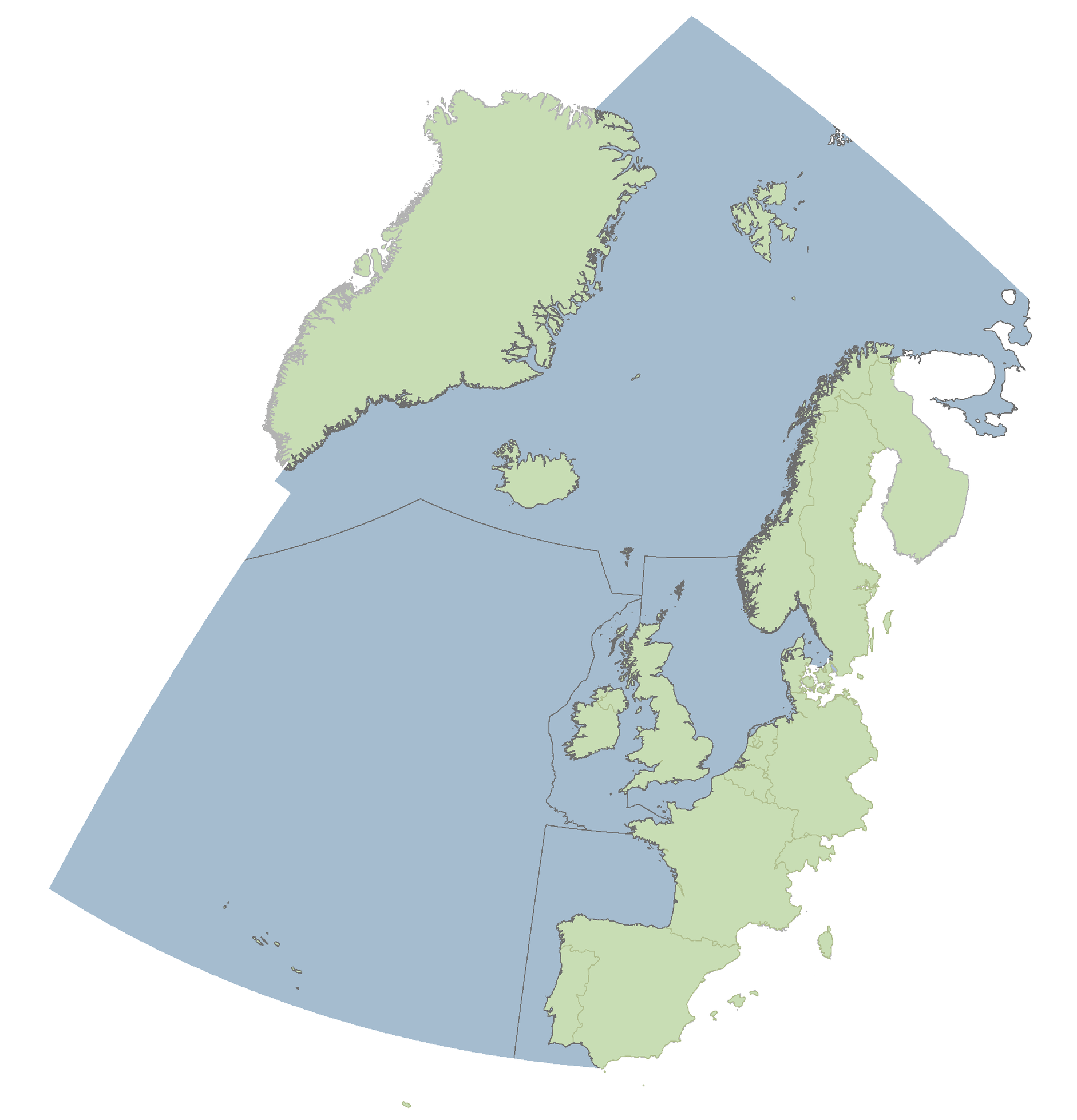
| Assessment of Status | Distribution | Population size | Demographics | Previous OSPAR status assessment | Status (overall assessment) | |
|---|---|---|---|---|---|---|
Region | I | ←→1 | ↓3 | ←→3 | ○ | good |
| II | ↓1 | ←→3 | ←→3 | ● | poor | |
| III | ? | ↓3 | ←→3 | ● | poor | |
| IV | NA | |||||
| V | NA | |||||
Assessment of key pressures | Fisheries | Climate change | Threat or impact | |
|---|---|---|---|---|
Region | I | ←→3 | ←→3 | ←→3 |
| II | ↓3 | ↑3 | ↓3 | |
| III | ←→3 | ↑3 | ←→3 | |
| IV | NA | |||
| V | NA | |||
Explanation to table:
Distribution, Population size, Condition
Trends in status (since the assessment in the background document)
↓ decreasing trend or deterioration of the criterion assessed
↑ increasing trend or improvement in the criterion assessed
←→ no change observed in the criterion assessed
? trend unknown in the criterion assessed
Previous status assessment: If in QSR 2010 then enter Regions where species occurs ( ○) and has been recognised by OSPAR to be threatened and/or declining (● ) based on Chapter 10 Table 10.1 and Table 10.2 . If a more recent status assessment is available, then enter ‘poor’/’good’
Status*(overall assessment)
red – poor
green – good
? – status unknown
NA - Not Applicable
*applied to assessments of status of the feature or of a criterion, as defined by the assessment values used in the QSR 2023 or by expert judgement.
Key Pressure
↓ key pressures and human activities reducing
↑ key pressures and human activities increasing
←→ no change in key pressures and human activities
? Change in pressure and human activities uncertain
Threats or impacts (overall assessment)
red – significant threat or impact;
green–no evidence of a significant threat or impact
Blue cells – insufficient information available
NA – not applicable
OSPAR welcomes and adopts this independent scientific assessment prepared by ICES as advice to OSPAR in response to a special request as part of the ICES Work Programme 2023/24. Germany notes that the overall low and often declining stock sizes in Region I are a matter of concern
The West Greenland stocks are included in this Status Assessment because they are known to move around the southern tip of Greenland and into OSPAR Region I.
1 – direct data driven.
2 – indirect data driven.
3 – third party assessment, close-geographic match.
4 – third party assessment, partial-geographic match.
5 – expert judgement.
Confidence
High
Background information
Year added to OSPAR List: Year added to OSPAR list: 2003. A case report was published in 2008 (OSPAR, 2008).
The original evaluation against the Texel-Faial criteria referred to (OSPAR, 2014):
- Sensitivity: sensitive to fisheries and slow to recover from depletion.
- Keystone species: top predator historically shaping and stabilising its respective ecosystems.
- Decline: several stocks severely declined to about 5% or less of the unfished population and are currently outside safe biological limits.
The key pressures on cod stocks come from fisheries and human induced global warming.
Last status assessment: 2014. The OSPAR list identifies threat and/or in decline in Regions II and III. OSPAR (2014) identified threat and/or in decline in regions I, II, and III.
Geographical Range and Distribution
Atlantic cod is a benthopelagic species, distributed in a variety of habitats from the shoreline to depths of 600 m. Cod are distributed across the continental shelves of the North Atlantic and Arctic waters, from the Mid Atlantic Bight off the northeast coast of the United States to the Barents Sea off the coast of Russia (ICES, 2020).
A series of stocks exist throughout this range with characteristic life histories and ecology (e.g. ICES, 2005). Some cod groups are relatively sedentary, while others migrate seasonally between spawning and foraging grounds, with varying degrees of mixing after spawning (ICES, 2020).
Range contractions and distribution shifts have been reported for some stocks, driven by interactions between climate and fisheries.
Population/Abundance
Since the last assessment (OSPAR, 2014), the seven stocks and substocks (hereafter “stocks”) in Region I for which spawning stock biomass (SSB) estimates are available show a range of abundance trends, although the sum of SSB consistently decreases, primarily driven by the SSB of the large Northeast Arctic cod stock in ICES subareas 1 and 2 (cod.27.1-2; Figure 1). In Region II, abundance trends have fluctuated with similar total SSB at the start and end of the assessment period, excluding Kattegat cod (cod.27.21), which exhibits a near continuous decrease in SSB. In Region III, the abundance of both stocks and total SSB decreases over the assessment period.
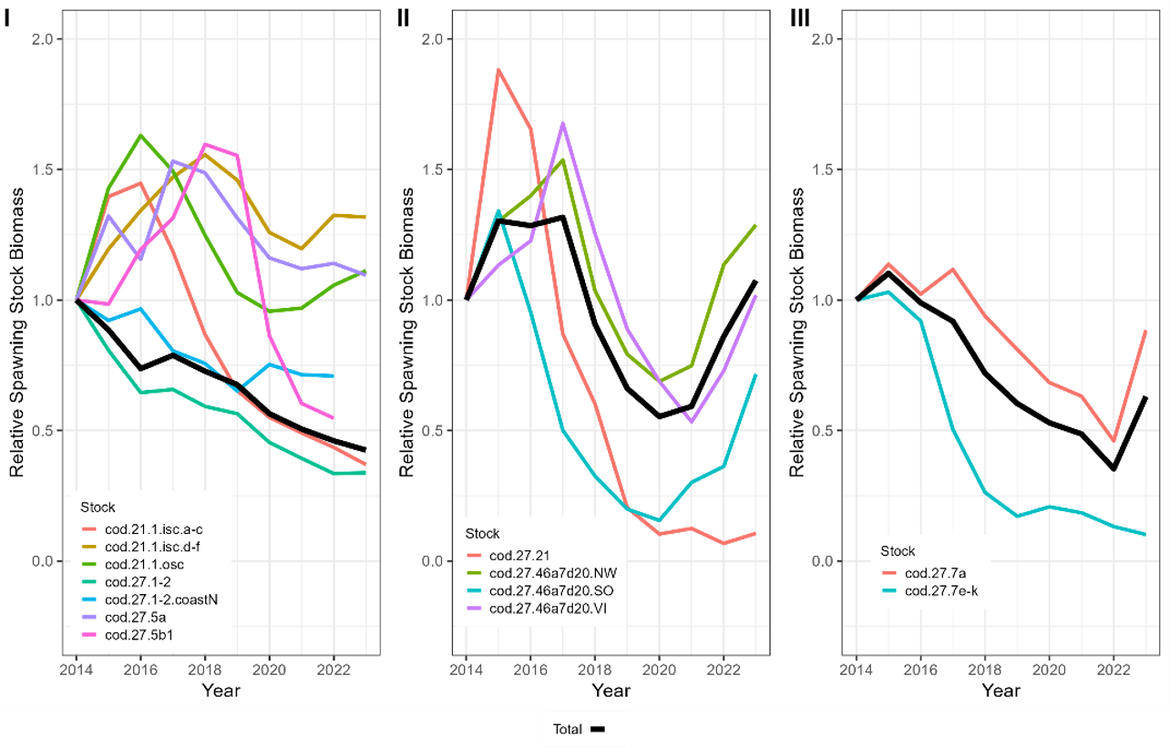
Figure 1: Normalised trends in cod spawning stock biomass (SSB) in OSPAR regions I–III since the last status assessment (OSPAR, 2014). Coloured lines represent different stocks and substocks, and codes follow Table A1.2. Black lines are normalized trends of combined SSB of stocks and substocks within regions.
Condition
There are estimates of SSB and reference points for 11 of 16 recognised stocks in regions I–III. Six of 10 stocks in Region I have SSB and reference points, five have full reproductive capacity, and one has reduced reproductive capacity (ICES, 2022a, 2022b, 2023a–f, IMR, 2023). In Region II, three of four stocks have SSB and reference points, one has full reproductive capacity, one has increased risk of reduced reproductive capacity, and one has reduced reproductive capacity (ICES, 2023g, 2023h). In Region III, the two assessed stocks have increased risk of reduced reproductive capacity and reduced reproductive capacity respectively (ICES, 2023i, 2023j). For the only recognised stock in the Wider Atlantic (OSPAR Region V), reference points are undefined (ICES, 2023k).
Threats and impacts
In the short to medium term, it is likely that the primary threat to the status of cod stocks comes from fisheries. This includes high fishing mortality resulting from some directed fisheries and from cod bycatches in mixed fisheries and fisheries targeting other species with smaller mesh sizes, particularly in Regions II and III. Fisheries at present are largely dependent on incoming year classes. The effects of climate change are likely contributing to varying demographic parameters (recruitment, growth, and natural mortality; [ICES, 2020 and references therein]), and the cumulative effects of these changes and fishing mortality may be causing range contraction.
Measures that address key pressures from human activities or conserve the species
All commercial fisheries for cod in regions I, II, III and the Bay of Biscay and Iberian Coast (OSPAR Region IV) are managed using a combination of technical measures (e.g. minimum conservation reference sizes, minimum mesh sizes for nets, use of selective gears, and closed areas and seasons) and/or effort or landings quota systems. Discarding of cod, although not permitted in most fisheries, is known to occur. Catches of cod for recreational and subsistence purposes are thought to form a substantial portion of total catch for some stocks but are generally poorly quantified and subject to fewer regulations. Management measures are determined either through unilateral processes or multilateral negotiations and include socio-economic considerations as well as scientific advice.
Conclusion (including management considerations)
In general, northern cod stocks in Region I have full reproductive capacity and sustainable exploitation rates while those in the more southerly Regions II and III tend to have reduced reproductive capacity and high exploitation rates. In Region I, cod are closer to the northern extreme of their range than in Regions II and III and are also expected to be more resilient to climate change.
For stocks with full reproductive capacity, decreasing SSB in the assessment period is unlikely to indicate poor status when total biomass remains above the limit. For stocks and substocks with reduced reproductive capacity or at increased risk of reduced reproductive capacity, decreasing SSB is treated as an indicator of poor status even if there is effective management of fishing mortality.
In Region I, four of 10 stocks have precautionary reference points for fishing mortality. Three of these stocks are harvested sustainably. One stock is at increased risk of unsustainable harvesting, although it remains at full reproductive capacity. In Region II, three of four stocks have precautionary reference points for fishing mortality. They are all harvested sustainably. In Region III, one of the two stocks with precautionary reference points for fishing mortality is at increased risk of unsustainable harvesting. Management of fishing mortality provides the primary lever to influence stock status.
Stock definitions, allocations to OSPAR Regions, and the numbers of stocks included in the assessment have all changed since the last status assessment. The previous assessment of poor status continues to apply to regions II and III but not to Region I.
Knowledge gaps
Tagging and routine stock composition sampling are required to further elucidate stock structure and seasonal movements and mixing within and between stocks, particularly of cod in regions II and III but also in coastal areas of Region I.
The contribution of both cannibalism and predation (notably but not exclusively by seals) to total cod mortality is likely to be significant in all regions. Further research is needed to quantify these sources of mortality.
While good quality data is available for Barents Sea and Icelandic stocks, data is sparser and more variable for many of the smaller stocks (including many coastal stocks in Region I and the Rockall cod), which translates to more uncertain and tentative determination of the stock status.
Method used
The assessment is based on ICES stock assessments, peer reviewed literature, and expert opinion.
ICES. 2005. Spawning and life history information for North Atlantic cod stocks. ICES Cooperative Research Reports (CRR). Report 274, 152pp. https://doi.org/10.17895/ices.pub.5478
ICES. 2020. Workshop on Stock Identification of North Sea Cod (WKNSCodID). ICES Scientific Reports. 2:89. 82 pp. http://doi.org/10.17895/ices.pub.7499
ICES. 2022a. Cod (Gadus morhua) in Subdivision 5.b.1 (Faroe Plateau). In Report of the ICES Advisory Committee, 2022. ICES Advice 2022, cod.27.5b1, https://doi.org/10.17895/ices.advice.19772368
ICES. 2022b. Cod (Gadus morhua) in Subdivision 5.b.2 (Faroe Bank). In Report of the ICES Advisory Committee, 2022. ICES Advice 2022, cod.27.5b2. https://doi.org/10.17895/ices.advice.19772371
ICES. 2023a. Cod (Gadus morhua) in NAFO Subarea 1 (West Greenland Inshore Spawning Cod). In Report of the ICES Advisory Committee, 2023. ICES Advice 2023, cod.21.1.isc, https://doi.org/10.17895/ices.advice.23259380
ICES. 2023b. Cod (Gadus morhua) in NAFO Subarea 1 (offshore) (West Greenland offshore spawning cod). In Report of the ICES Advisory Committee, 2023. ICES Advice 2023, cod.21.1.osc, https://doi.org/10.17895/ices.advice.23266232
ICES. 2023c. Cod (Gadus morhua) in subareas 1 and 2 north of 67°N (Norwegian Sea and Barents Sea), northern Norwegian coastal cod. In Report of the ICES Advisory Committee, 2023. ICES Advice 2023, cod.27.1-2coastN, https://doi.org/10.17895/ices.advice.21828306
ICES. 2023d. Cod (Gadus morhua) in Subarea 2 between 62°N and 67°N (Norwegian Sea), southern Norwegian coastal cod. In Report of the ICES Advisory Committee, 2023. ICES Advice 2023, cod.27.1-2coastS, https://doi.org/10.17895/ices.advice.21828309
ICES. 2023e. Cod (Gadus morhua) in Division 5.a (Iceland grounds). In Report of the ICES Advisory Committee, 2023. ICES Advice 2023, cod.27.5a, https://doi.org/10.17895/ices.advice.21828315
ICES. 2023f. Cod (Gadus morhua) in NAFO Subarea 1 and ICES Subarea 14 (East Greenland Iceland offshore spawning cod). In Report of the ICES Advisory Committee, 2023. ICES Advice 2023, cod.2127.1.14.osc, https://doi.org/10.17895/ices.advice.21828291
ICES. 2023g. Cod (Gadus morhua) in Subdivision 21 (Kattegat). In Report of the ICES Advisory Committee, 2023. ICES Advice 2023, cod.27.21. https://doi.org/10.17895/ices.advice.21820488
ICES. 2023h. Cod (Gadus morhua) in Subarea 4, divisions 6.a and 7.d, and Subdivision 20 (North Sea, West of Scotland, eastern English Channel and Skagerrak). In Report of the ICES Advisory Committee, 2023.
ICES Advice 2023, cod.27.46a7d20. https://doi.org/10.17895/ices.advice.21840765
ICES. 2023i. Cod (Gadus morhua) in Division 7.a (Irish Sea). In Report of the ICES Advisory Committee, 2023. ICES Advice 2023, cod.27.7a. https://doi.org/10.17895/ices.advice.21840786
ICES. 2023j. Cod (Gadus morhua) in Division 7.e–k (eastern English Channel and southern Celtic Seas). In Report of the ICES Advisory Committee, 2023. ICES Advice 2023, cod.27.7e–k. https://doi.org/10.17895/ices.advice.21840789
ICES. 2023k. Cod (Gadus morhua) in Division 6.b (Rockall). In Report of the ICES Advisory Committee, 2023. ICES Advice 2023, cod.27.6b. https://doi.org/10.17895/ices.advice.21840771
IMR, 2023. Advice on fishing opportunities for Northeast Arctic cod in 2024 in ICES subareas 1 and 2: cod.27.1-2 https://www.hi.no/hi/nettrapporter/imr-pinro-en-2023-5.
OSPAR. 2008. Nomination Gadus morhua, Cod. Case Reports for the OSPAR List of Threatened and/or Declining Species and Habitats. OSPAR Commission: 115–117.
OSPAR. 2014. Background Document for Atlantic cod Gadus morhua. OSPAR Commission. 31 pp.
Sheet reference:
BDC2026/Atlantic cod